
Coverage Germany
Audio Guide Trier
app, one-time €4.99
Trier is Germany's oldest city, a former Roman imperial capital on the Moselle where a 2,000-year-old city gate still stands at the end of a shopping street. From a throne room built for Constantine the Great to the birthplace of Karl Marx, the layers here run unusually deep.
40+ researched places in the app
Yes. Parroo is a self-guided audio guide for Trier: 40 researched places, from Porta Nigra to Trier Cathedral and Constantine Basilica, each with a short summary, a full article, and a roughly three-minute audio story in German, English, and French. Buy once, no subscription, no booking. Start whenever you like.
Audio sample: Porta Nigra
Trier
Places researched in this city
A selection of the 40 places we've researched in this city. The full set is in the Parroo app.
- Roman monuments
- Gothic churches
- Imperial baths
- Medieval squares
- Riverside walks
-
01
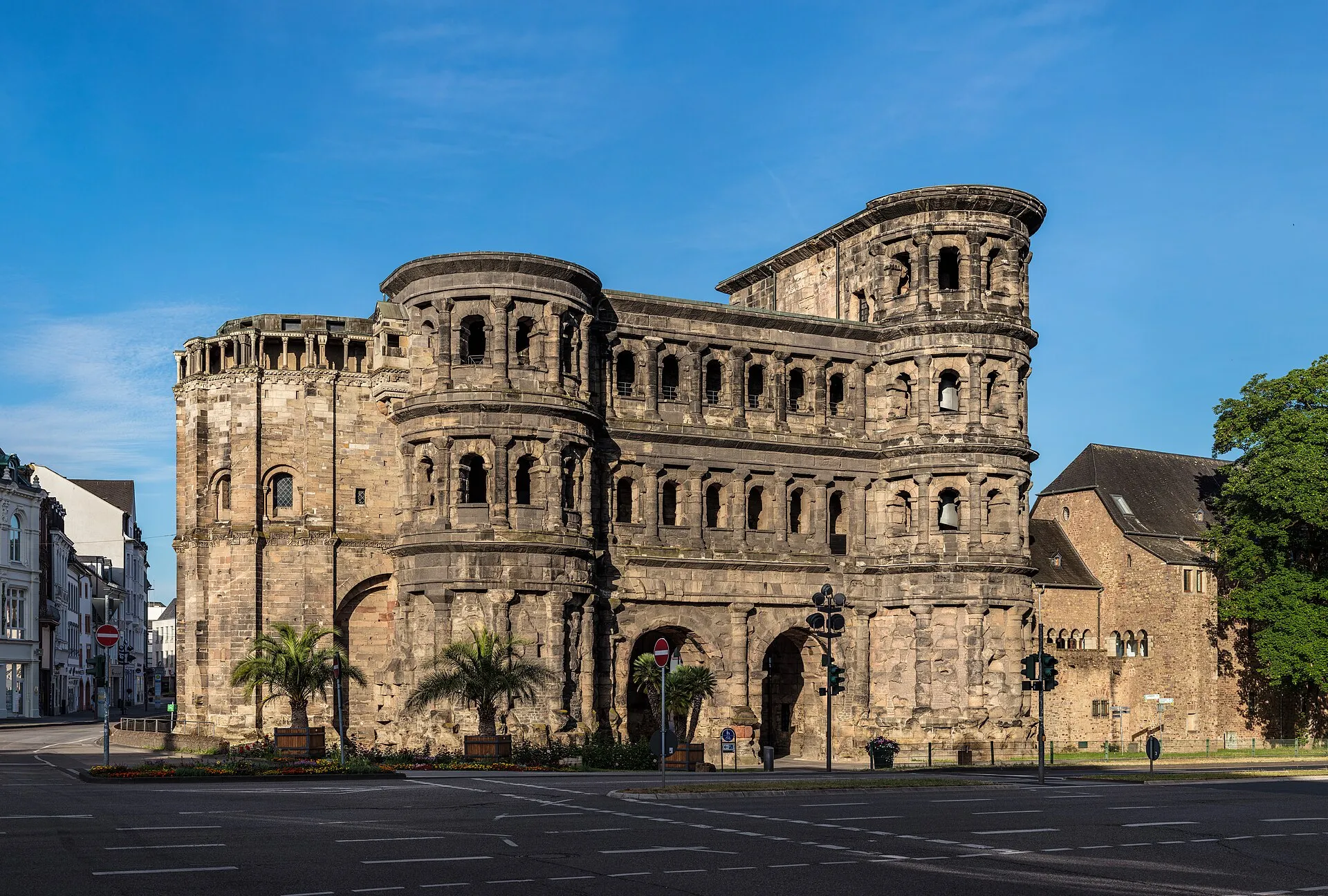
Porta Nigra
A Greek monk named Simeon lived as a hermit inside this Roman city gate for years after 1028, and his presence is the main reason the structure survived the Middle Ages intact. Built around 170 AD from 7,200 sandstone blocks held together without mortar, it remains the largest preserved Roman city gate north of the Alps.
-
02
Trier Cathedral
Germany's oldest bishop's church shelters a relic claimed to be the tunic worn by Christ at his crucifixion, drawing pilgrims for centuries. The building began as a Roman residential complex in the 2nd century, was transformed into a place of worship around 310 AD, and has been in continuous religious use ever since.
-
03
Constantine Basilica
Constantine the Great held imperial audiences in this vast brick hall, which at 67 meters long and 33 meters high has stood without a roof collapse for 1,700 years. It is the largest surviving single-room structure from antiquity and today serves as a Protestant church.
-
04
Imperial Baths
Planned as one of the grandest bath complexes in the Roman Empire, the Kaiserthermen were never actually finished as baths: they were repurposed as barracks and later as a medieval castle before the project was abandoned. Covering 37,000 square meters, their underground tunnel system is still walkable today.
-
05
Church of Our Lady (UNESCO)
Built around 1230 using craftsmen brought from Champagne and the Île-de-France, this is considered the earliest church in French High Gothic style constructed outside France. Its unusual circular cruciform floor plan, with twelve columns symbolising the Apostles, was laid directly on the ruins of a Roman double church endowed by Emperor Constantine in 326 AD.
-
06
Karl Marx House
The Social Democratic Party bought this 1727 Baroque townhouse in 1928 and opened it as a museum in 1931, only for the Nazi regime to confiscate it shortly afterwards. Karl Marx was born here on 5 May 1818 and the family moved out just eighteen months later, meaning he never knew the place he is most associated with.
-
07
St. Matthias Abbey
During construction work in 1127, workers uncovered remains believed to be those of the Apostle Matthias, making this the only site north of the Alps that claims an apostle's grave. Founded in the 5th century on a late antique burial ground, the Romanesque basilica consecrated in 1148 still receives thousands of pilgrims each year.
-
08
33 more places to discover
In the Parroo app
Good to know
40 researched places, from the Porta Nigra and the Constantine Basilica to lesser-known spots like St. Matthias Abbey. Each one has a short summary, a full article, and a ~3-minute audio story.
Yes. Every place has a ~3-minute audio story, written from the perspective of a guide standing next to you and produced with premium narration, not the article read aloud.
German, English, and French. Pick whichever you'd rather read or listen in.
No booking, no signup. It's a self-guided walk you start whenever you like. You do need a connection for now to stream the audio and load articles; offline support is something we're still building.
A one-time €4.99 for the whole city, no subscription and no recurring cost. You buy Trier once and keep access to all 40 places with text and audio.
Nearby cities
Open this city in Parroo
Get the full articles, audio stories, and map for this city in the Parroo app. One payment per geography. Yours to keep.
Updated: 2026-09-25