
Coverage Germany
Audio Guide Koblenz
app, one-time €4.99
Koblenz sits at the precise point where the Moselle flows into the Rhine, a confluence that has shaped the city since the Romans founded a military post here around 9 BCE. Above it all, Ehrenbreitstein Fortress watches from 180 meters up, reachable by a cable car that was only meant to be temporary. The old town, the riverside promenades, and a string of castles along the Rhine make this one of the most layered cities in the Middle Rhine valley.
43+ researched places in the app
Yes. Parroo is a self-guided audio guide for Koblenz: 43 researched places, from Ehrenbreitstein Fortress to German Corner and Basilica of St. Castor, each with a short summary, a full article, and a roughly three-minute audio story in German, English, and French. Buy once, no subscription, no booking. Start whenever you like.
Audio sample: Ehrenbreitstein Fortress
Koblenz
Places researched in this city
A selection of the 43 places we've researched in this city. The full set is in the Parroo app.
- Romanesque churches
- Rhine-Moselle confluence
- Medieval castles
- Prussian fortresses
- Riverside promenades
- Bronze monuments
-
01
Ehrenbreitstein Fortress
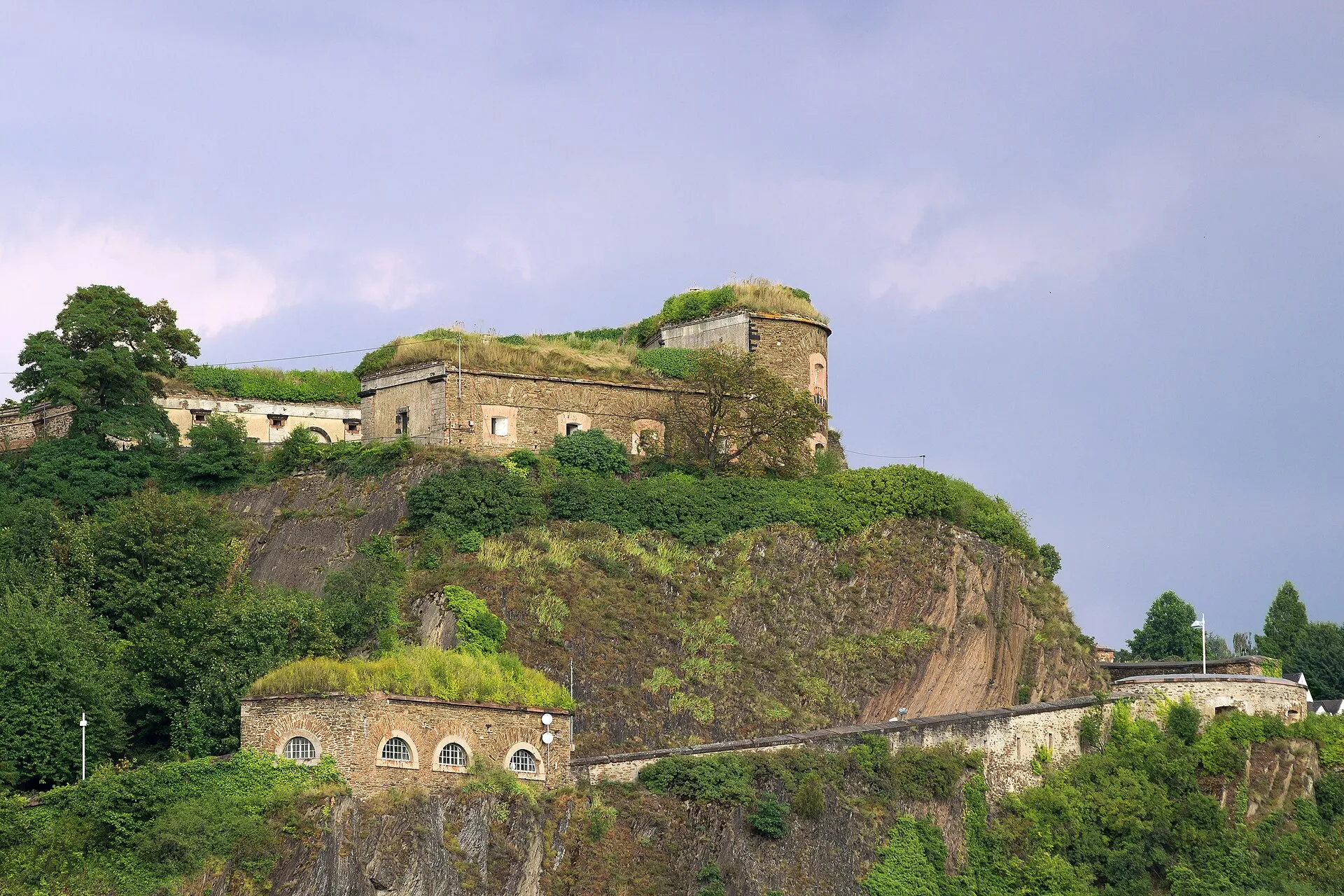
The baroque predecessor of this fortress was blown up by French Revolutionary troops in 1801; the Prussians rebuilt it between 1817 and 1828 on a scale so vast it covers 1.5 square kilometers of basalt and slate. Today it houses the Landesmuseum Koblenz and offers a panoramic view over both rivers that you can reach by cable car.
-
02
German Corner
The Teutonic Order founded a commandery here in 1216, giving this pointed spit of land between the Rhine and Moselle its name long before it became a symbol of German unification. The 14-meter bronze equestrian statue of Kaiser Wilhelm I was destroyed in World War II and replaced with a replica only in 1993.
-
03
Basilica of St. Castor
Built between 817 and 836, this Romanesque basilica hosted the negotiations that led to the Treaty of Verdun in 843, the agreement that split Charlemagne's empire and shaped the map of Europe. Its 44-meter towers and late Gothic star vault have dominated the riverside skyline ever since.
-
04
Stolzenfels Castle
After French troops destroyed the original 13th-century toll castle in 1689, the ruins sat abandoned for over 150 years until the city of Koblenz gifted them to Crown Prince Frederick William of Prussia in 1823. He had Karl Friedrich Schinkel rebuild it as a Neo-Gothic summer residence, completed in 1842, surrounded by gardens laid out by Peter Joseph Lenné.
-
05
Electoral Palace
Built between 1777 and 1793 for Clemens Wenzeslaus of Saxony, the last Archbishop-Elector of Trier, this neoclassical palace was barely finished before the elector fled the approaching French Revolutionary Army in 1794. It is considered one of the last great German residences built before the French Revolution.
-
06
Schängel Fountain
The word 'Schängel' started as a derogatory nickname for children born to French soldiers and local women during the French occupation of 1794 to 1814, before Koblenz natives adopted it as a badge of honor. Carl Burger's 1941 bronze boy still spits water at unsuspecting visitors in Willi-Hörter-Platz today.
-
07
Knight's Fall
This 166-meter cliff above the Rhine is geologically ancient Lower Devonian slate, but its modern significance comes from a single weekend in July 1948, when German state leaders met here for the Rittersturz Conference and passed the resolutions that set the Federal Republic of Germany in motion. A basalt monument erected in 1978 marks where that decision was made.
-
08
36 more places to discover
In the Parroo app
Good to know
43 researched places, from Ehrenbreitstein Fortress and the Basilica of St. Castor to lesser-known spots like the Schängel Fountain. Each one has a short summary, a full article, and a ~3-minute audio story.
Yes. Every place has a ~3-minute audio story, written from the perspective of a guide standing next to you and produced with premium narration, not the article read aloud.
German, English, and French. Pick whichever you'd rather read or listen in.
No booking, no signup. It's a self-guided walk you start whenever you like. You do need a connection for now to stream the audio and load articles; offline support is something we're still building.
A one-time €4.99 for the whole city, no subscription and no recurring cost. You buy Koblenz once and keep access to all 43 places with text and audio.
Nearby cities
Open this city in Parroo
Get the full articles, audio stories, and map for this city in the Parroo app. One payment per geography. Yours to keep.
Updated: 2026-09-25