
Coverage Germany
Audio Guide Flensburg
app, one-time €4.99
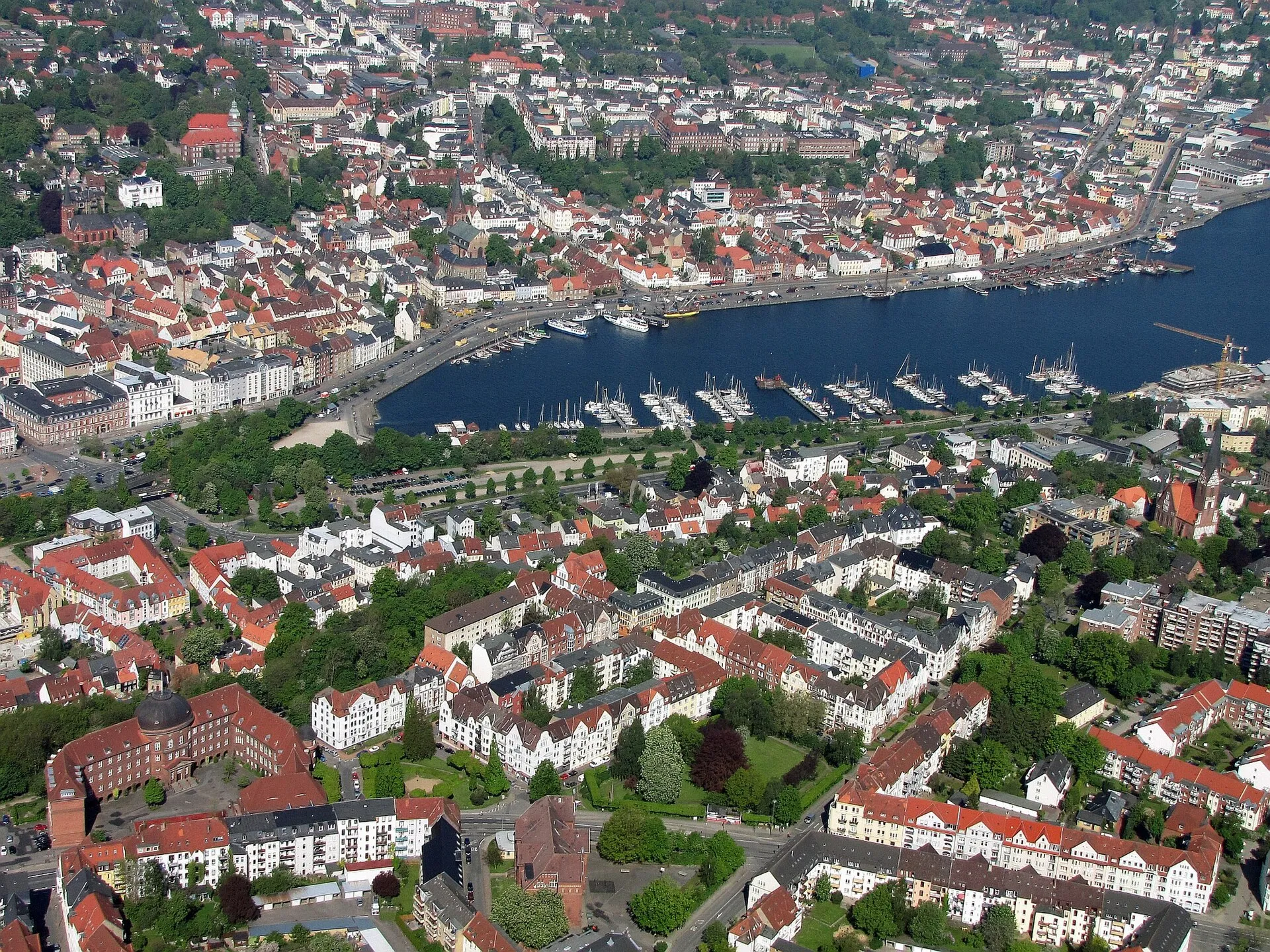
Flensburg sits at the very tip of a narrow fjord, just a few kilometres from the Danish border, and its whole character is shaped by that in-between position: part Hanseatic trading port, part Danish-German frontier town. The city made its fortune on rum and sugar from the West Indies, and that story still runs through its courtyards, harbour quays, and the oldest flip-top beer bottle in Northern Germany.
32+ researched places in the app
Parroo is a self-guided audio guide for Flensburg: 32 researched places, from the Nordertor and St. Nicholas Church to the historic harbour, each with a short summary, a full article, and a roughly three-minute audio story in German, English, and French. Buy once, no subscription, no booking. Start whenever you like.
Audio sample: North Gate (Nordertor)
Flensburg
Places researched in this city
A selection of the 32 places we've researched in this city. The full set is in the Parroo app.
- Brick Renaissance gate
- Gothic churches
- Historic harbour
- Border town heritage
- Fjord shoreline
-
01
North Gate (Nordertor)
The only surviving city gate in Schleswig-Holstein, built in 1595-1596, it carries King Christian IV's coat of arms on its stepped gable and still hosts civil weddings inside its archway today. It stood as the northern boundary of Flensburg for two full centuries.
-
02
St. Nicholas Church
Merchants who traded with the patron saint of sailors built this Brick Gothic hall church between 1390 and 1480, raising a 90-metre spire that still dominates the skyline. Inside, a bronze baptismal font from 1497 and a Renaissance organ survive from that prosperous era.
-
03
St. Mary's Church
Flensburg's oldest inner-city church traces its origins to a Romanesque structure under King Valdemar I around 1165, destroyed in a dynastic conflict in 1248 and rebuilt in Gothic brick from 1284. The document confirming its reconstruction is preserved in the city archive at the town hall.
-
04
Historic Harbour Flensburg
A private group of shipowners rebuilt the old timber quay in 1979 and gathered a fleet of traditional Baltic working vessels around it. Every year the Rum-Regatta and the Dampf-Rundum festival draw thousands of visitors back to the waterfront that once handled Caribbean sugar and raw rum.
-
05
Naval School Mürwik
Modelled on the medieval fortress of Marienburg and built in red Brick Gothic between 1907 and 1910, this 200-metre anchor-shaped complex served as the seat of the last government of the Third Reich in May 1945. It still trains German naval officers today.
-
06
Idstedt Lion (Old Cemetery)
This 4-metre bronze lion was unveiled in Flensburg in 1862 to honour Danish soldiers who died at the Battle of Isted in 1850, then carried off to Berlin as a trophy when Prussia took the city in 1864. It spent over a century in Copenhagen before finally returning to Flensburg in 2011, now read as a symbol of German-Danish reconciliation.
-
07
Oluf Samson Alley
A merchant from the Danish island of Samsø built this narrow lane connecting Norderstraße to the harbour in the late 16th century, filling it with small rental houses for the city's poorest residents. By the 20th century it had become a red-light district; today its 18th-century half-timbered houses are listed monuments and quiet residential addresses.
-
08
25 more places to discover
In the Parroo app
Good to know
32 researched places, from the Nordertor and St. Nicholas Church to lesser-known spots like the Oluf Samson Alley. Each one has a short summary, a full article, and a ~3-minute audio story.
Yes. Every place has a ~3-minute audio story, written from the perspective of a guide standing next to you and produced with premium narration, not the article read aloud.
German, English, and French. Pick whichever you'd rather read or listen in.
No booking, no signup. It's a self-guided walk you start whenever you like. You do need a connection for now to stream the audio and load articles; offline support is something we're still building.
A one-time €4.99 for the whole city, no subscription and no recurring cost. You buy Flensburg once and keep access to all 32 places with text and audio.
Nearby cities
Other audio guides and tours here
Parroo isn't the only option. Here are honest local alternatives so you can compare for yourself.
- Tourismus Agentur Flensburger Förde · Guided tour. Official guided old town and harbour walks.
- Musement · Self-guided audio tour. Bookable self-guided audio tour of the old town and harbour, about 2.5 hours.
Open this city in Parroo
Get the full articles, audio stories, and map for this city in the Parroo app. One payment per geography. Yours to keep.
Updated: 2026-09-17