
Coverage Germany
Audio Guide Lübeck
app, one-time €4.99
Lübeck is the old queen of the Hanseatic League, a brick-built island city whose seven church towers have defined its skyline for centuries. Founded in 1143 and a UNESCO World Heritage Site since 1987, it gave the world Brick Gothic architecture, Thomas Mann's Nobel Prize-winning novel, and a very serious claim to the finest marzipan in Europe.
43+ researched places in the app
Parroo is a self-guided audio guide for Lübeck: 43 researched places, from the Holsten Gate to the Salt Storehouses, each with a short summary, a full article, and a roughly three-minute audio story in German, English, and French. Buy once, no subscription, no booking. Start the walk whenever you like.
Audio sample: Holsten Gate
Lübeck
Places researched in this city
A selection of the 43 places we've researched in this city. The full set is in the Parroo app.
- Brick Gothic churches
- Medieval gates
- Hanseatic history
- Literary heritage
- Maritime heritage
- Historic squares
-
01
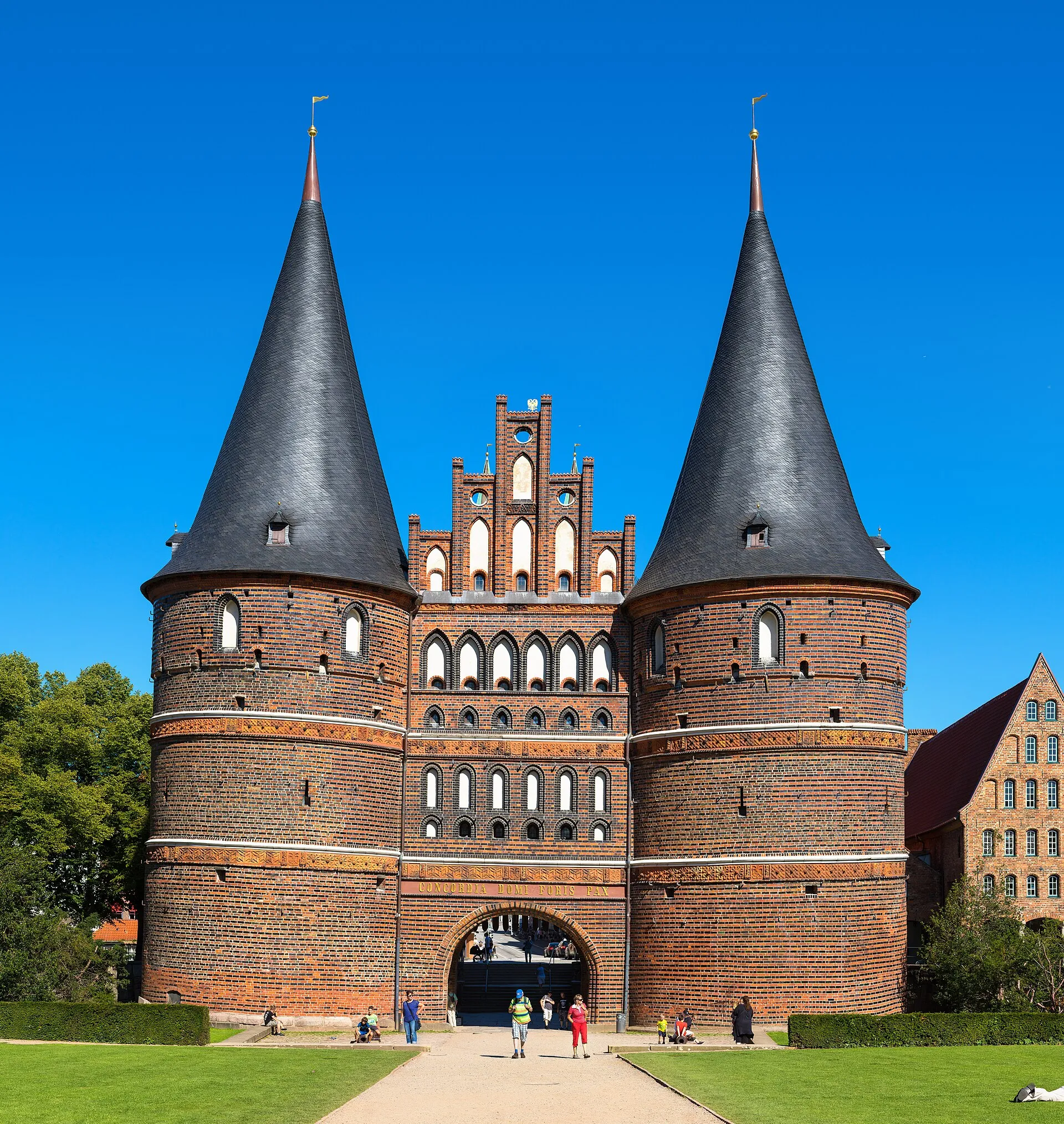
Holsten Gate
Its cannons were never once fired in anger, yet the Holstentor became the ultimate symbol of Hanseatic power: completed in 1478, its 3.5-metre-thick walls and twin towers carry the inscription "CONCORDIA DOMI FORIS PAX" (harmony at home, peace abroad). Today it houses Lübeck's city history museum.
-
02
St. Mary's Church
Built between 1265 and 1352 by Lübeck's merchants to outshine the nearby cathedral, St. Mary's holds the record for the world's highest brick vaults at 38.5 metres and went on to inspire roughly 70 churches across the Baltic. A set of bells shattered in the 1942 bombing raid still lies where they fell, as a permanent memorial.
-
03
Buddenbrook House
The Rococo façade bearing the motto "Dominus providebit" (The Lord will provide) survived the 1942 bombing that gutted the interior, which is fitting: Thomas Mann's grandfather bought this 1758 house, and Mann turned its walls into the setting for his Nobel Prize-winning novel "Buddenbrooks." It has been a literature museum since 1993.
-
04
Holy Spirit Hospital
Founded in 1227 and completed in 1286, this is one of the oldest social welfare institutions in Europe, built by Lübeck merchants to care for the sick and elderly long before the modern state existed. Its three-gabled North German Brick Gothic façade still anchors the Koberg square today.
-
05
Lübeck Cathedral
Henry the Lion founded this cathedral in 1173 as his personal prestige project, making it the first large brick church on the entire Baltic coast. At 131 metres long with towers approaching 115 metres, it dwarfs most of its competitors, and a 17-metre triumphal cross by master carver Bernt Notke dominates the interior.
-
06
Salt Storehouses
Before these six brick warehouses were built between 1579 and 1745, the same spot held nine wooden herring stalls dating back to 1262, where merchants packed fish in salt for Baltic markets. The warehouses stored Lüneburg salt transported along the Old Salt Route, and their stepped Brick Renaissance gables served as the backdrop for F.W. Murnau's 1922 vampire film "Nosferatu."
-
07
Four-masted barque Passat
Built by Blohm and Voss in 1911, this 115-metre steel sailing ship rounded Cape Horn 39 times and completed two full circumnavigations of the globe before being retired in 1957. Moored permanently in Travemünde since 1960, it is now the most tangible reminder of the era when Lübeck's ships traded on every ocean.
-
08
36 more places to discover
In the Parroo app
Good to know
43 researched places, from the Holsten Gate and St. Mary's Church to lesser-known spots like the Salt Storehouses. Each one has a short summary, a full article, and a ~3-minute audio story.
Yes. Every place has a ~3-minute audio story, written from the perspective of a guide standing next to you and produced with premium narration, not the article read aloud.
German, English, and French. Pick whichever you'd rather read or listen in.
No booking, no signup. It's a self-guided walk you start whenever you like. You do need a connection for now to stream the audio and load articles; offline support is something we're still building.
A one-time €4.99 for the whole city, no subscription and no recurring cost. You buy Lübeck once and keep access to all 43 places with text and audio.
Other audio guides and tours here
Parroo isn't the only option. Here are honest local alternatives so you can compare for yourself.
- Lübeck-Tourismus · Guided tour. Official guided old town walks with a guide, about 2 hours, from €14, at set times.
- SmartGuide · Audio guide app. Self-guided audio app covering Lübeck (Lübeck in a Nutshell tour), freemium.
- GetYourGuide · Booking marketplace. Marketplace listing individual Lübeck audio guides and tours.
Open this city in Parroo
Get the full articles, audio stories, and map for this city in the Parroo app. One payment per geography. Yours to keep.
Updated: 2026-09-17