
Coverage Germany
Audio Guide Hamburg
Hamburg is a port city that has traded with the world for over 800 years, and the waterfront still defines everything about it. The Elbphilharmonie rises over a former cocoa warehouse, the Speicherstadt's red-brick canals are a UNESCO World Heritage Site, and the Reeperbahn's rope-making past led directly to the Beatles. There is a lot going on here, and Parroo has the stories behind it.
75+ researched places in the app
Yes. Parroo is a self-guided audio guide for Hamburg: 75 researched places, from Elbphilharmonie to Speicherstadt and Hamburg City Hall, each with a short summary, a full article, and a roughly three-minute audio story in German, English, and French. Buy once, no subscription, no booking. Start whenever you like.
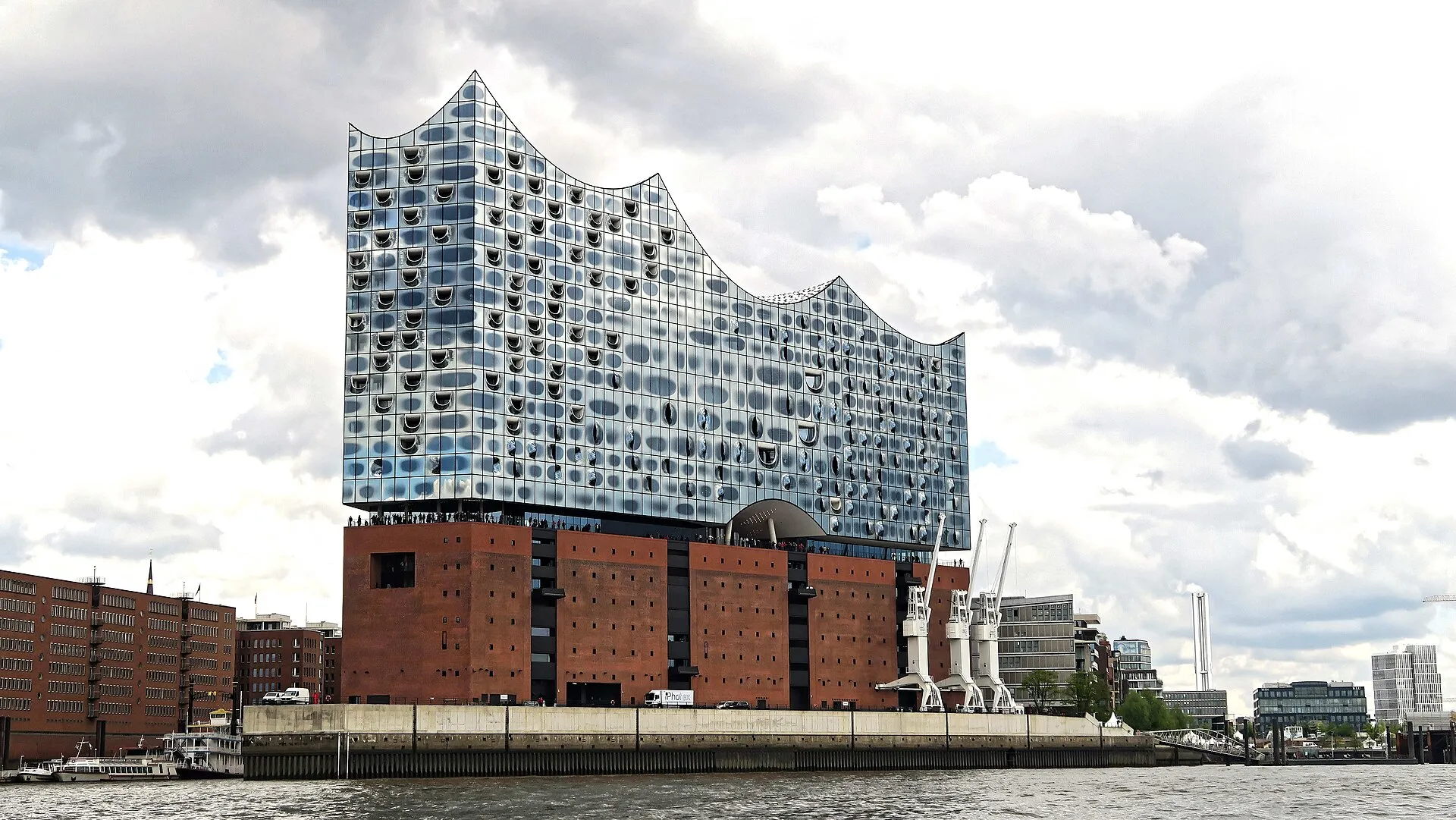
Audio sample: Elbphilharmonie
Hamburg
Places researched in this city
A selection of the 75 places we've researched in this city. The full set is in the Parroo app.
- Concert hall
- Warehouse district
- Baroque church
- Medieval market
- Maritime heritage
- City hall
-
01
Elbphilharmonie
Built on top of a warehouse that once stored tea, tobacco, and cocoa, the Elbphilharmonie took so long and cost so much (866 million euros) that it became a national controversy before it became a national icon. Herzog and de Meuron's wave-shaped glass tower opened in 2017 and now stands as Hamburg's tallest inhabited building at 110 metres.
-
02
Speicherstadt
To build this UNESCO-listed warehouse district, over 20,000 residents were displaced from the Elbe islands of Kehrwieder and Wandrahm starting in 1883. The resulting neo-Gothic complex of red-brick buildings on 3.5 million oak piles became the world's largest warehouse district and a free economic zone where goods could be transferred without paying customs.
-
03
Hamburg City Hall
During the November Revolution of 1918, workers stormed this building and raised the red flag from its 112-metre tower. Built between 1886 and 1897 on over 4,000 oak piles, the Neo-Renaissance Rathaus has 647 rooms and a courtyard fountain erected in memory of the 1892 cholera epidemic.
-
04
St. Michael's Church
Hamburg's most recognisable tower has burned down twice and been rebuilt both times: once after a lightning strike in 1750 and again after a fire during roof repairs in 1906. The current baroque church holds over 2,000 worshippers and its 132-metre tower carries Germany's largest church clock, long used as a navigation point on the Elbe.
-
05
St. Nikolai Memorial
When its 147.4-metre spire was completed in 1874, this neo-Gothic church was the tallest building in the world. During the Second World War, the Luftwaffe used it as a navigation reference for bombing raids, which is part of why the ruins were left standing as a memorial to the victims of war and tyranny.
-
06
Chilehaus
Its upper floors taper to a sharp point like a ship's prow, which is exactly what architect Fritz Höger intended when he completed this Brick Expressionist tower in 1924 for a merchant whose fortune came from Chilean saltpetre. Built from 4.8 million hand-laid clinker bricks, it anchors Europe's first dedicated office district and has been a UNESCO World Heritage Site since 2015.
-
07
Ohlsdorf Cemetery
Opened in 1877 and covering 389 hectares, this is the largest park cemetery in the world, and it won the Grand Prix at the 1900 Paris World Exposition. Wilhelm Cordes designed it in the style of an English landscape garden, complete with over 36,000 trees and 15 ponds, so that it functions equally as a burial site and a public park.
-
08
68 more places to discover
In the Parroo app
Good to know
75 researched places, from the Elbphilharmonie and the Speicherstadt to lesser-known spots like Ohlsdorf Cemetery. Each one has a short summary, a full article, and a ~3-minute audio story.
Yes. Every place has a ~3-minute audio story, written from the perspective of a guide standing next to you and produced with premium narration, not the article read aloud.
German, English, and French. Pick whichever you'd rather read or listen in.
No booking, no signup. It's a self-guided walk you start whenever you like. You do need a connection for now to stream the audio and load articles; offline support is something we're still building.
Open this city in Parroo
Get the full articles, audio stories, and map for this city in the Parroo app. One payment per geography. Yours to keep.
Updated: 2026-09-25