
Coverage Germany
Audio Guide Wismar
app, one-time €4.99
Wismar is a compact Hanseatic port city on the Baltic whose medieval core has changed so little that UNESCO inscribed it as a World Heritage Site in 2002. Three towering Brick Gothic churches, a vast market square, and a working old harbour tell the story of a city that was once among northern Europe's most powerful trading hubs, then spent 155 years under Swedish rule before quietly rejoining Germany in 1803.
19+ researched places in the app
Yes. Parroo is a self-guided audio guide for Wismar: 19 researched places, from St. Nicholas Church to Market Square Wismar and Water Art (Wasserkunst), each with a short summary, a full article, and a roughly three-minute audio story in German, English, and French. Buy once, no subscription, no booking. Start whenever you like.
Audio sample: St. Nicholas Church
Wismar
Places researched in this city
A selection of the 19 places we've researched in this city. The full set is in the Parroo app.
- Brick Gothic churches
- Hanseatic market square
- Medieval harbour
- Renaissance pavilions
- Gothic townhouses
-
01
St. Nicholas Church
The only one of Wismar's three great parish churches to survive World War II largely unscathed, St. Nicholas was built between 1381 and 1487 for the city's seafarers and fishermen, and its nave rises to 37 metres, making it one of the tallest Brick Gothic interiors in Germany. A slender spire once crowned the tower until a storm brought it down in 1703, taking the roof and vaulting with it.
-
02
Market Square Wismar
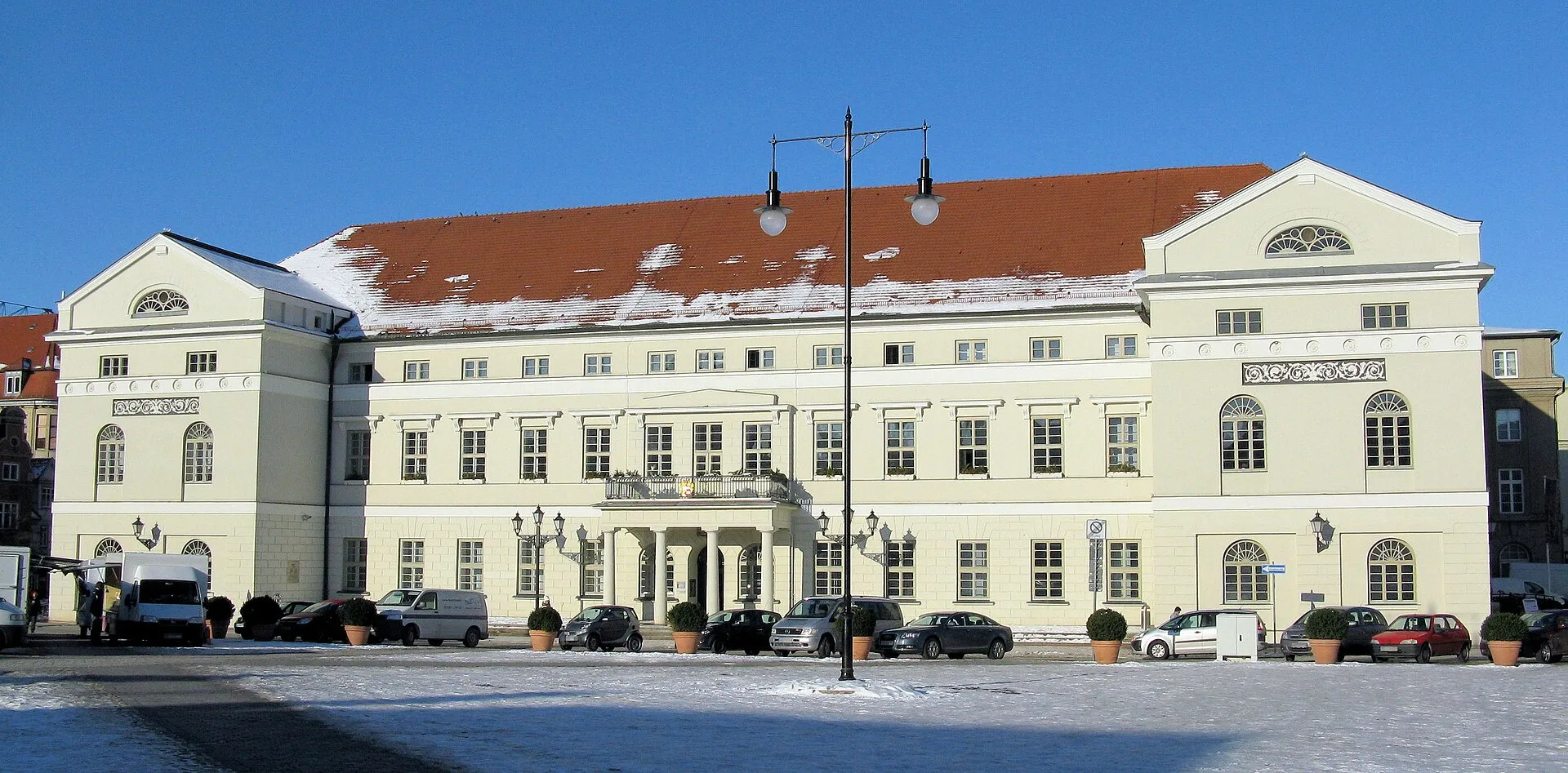
At 10,000 square metres, this is one of the largest medieval market squares in northern Germany, ringed by buildings from the Gothic to the Neoclassical that together read like a timeline of the city. The Wasserkunst Renaissance pavilion at its centre actually supplied the city with drinking water from 1602 until as recently as 1897.
-
03
Water Art (Wasserkunst)
This 12-sided limestone pavilion with a copper dome was built between 1579 and 1602 by Dutch master builder Philipp Brandin, and it was the city's main waterworks for nearly three centuries. The choice of a Dutch Renaissance architect was no accident: the design signals the deep commercial ties between Wismar and the Low Countries during the Hanseatic era.
-
04
St. Mary's Church Tower
The church that surrounded this 80-metre Brick Gothic tower was demolished in 1960, leaving the tower standing alone as a kind of monument to postwar decisions as much as medieval ambition. Its clock face measures five metres across, and twelve bells still ring from a structure that once guided ships into harbour.
-
05
St. George's Church
Construction on this three-aisled basilica began in 1404 and dragged on until 1594, meaning it took nearly two centuries to build what you see today. Severely damaged in World War II and then left as a shell through the East German decades, it was only fully restored by 2010, making its reopening something of a symbol of post-reunification recovery.
-
06
Water Gate (Wassertor)
Built around 1450, this is the sole survivor of the five gates that once pierced Wismar's city walls, the other four having been demolished in 1869 and 1870 during industrial expansion. Film enthusiasts may recognise it: the gate appeared in the 1922 horror film Nosferatu, used as a stand-in for the fictional city of Transylvania.
-
07
Old Swede (Alter Schwede)
Dating to around 1380, this stepped-gable Brick Gothic townhouse on the market square is the oldest surviving residential building in Wismar, and it was only given its current name in the 19th century to commemorate the 155 years of Swedish rule that ended in 1803. A carved Swedish head above the entrance door marks that connection to this day.
-
08
12 more places to discover
In the Parroo app
Good to know
19 researched places, from St. Nicholas Church and the Market Square to lesser-known spots like the Water Gate. Each one has a short summary, a full article, and a ~3-minute audio story.
Yes. Every place has a ~3-minute audio story, written from the perspective of a guide standing next to you and produced with premium narration, not the article read aloud.
German, English, and French. Pick whichever you'd rather read or listen in.
No booking, no signup. It's a self-guided walk you start whenever you like. You do need a connection for now to stream the audio and load articles; offline support is something we're still building.
A one-time €4.99 for the whole city, no subscription and no recurring cost. You buy Wismar once and keep access to all 19 places with text and audio.
Open this city in Parroo
Get the full articles, audio stories, and map for this city in the Parroo app. One payment per geography. Yours to keep.
Updated: 2026-09-25