
Coverage Germany
Audio Guide Cologne
app, one-time €4.99
Cologne is defined by its skyline-dominating cathedral, two millennia of Roman and medieval history, and a brewing tradition that gave the world Kölsch. The city was over 90% destroyed in World War II yet rebuilt its Romanesque churches, its Rhine bridges, and its ancient old town almost from scratch, making every street a lesson in resilience.
69+ researched places in the app
Yes. Parroo is a self-guided audio guide for Cologne: 69 researched places, from Cologne Cathedral to Museum Ludwig and Hohenzollern Bridge, each with a short summary, a full article, and a roughly three-minute audio story in German, English, and French. Buy once, no subscription, no booking. Start whenever you like.
Audio sample: Cologne Cathedral
Cologne
Places researched in this city
A selection of the 69 places we've researched in this city. The full set is in the Parroo app.
- Gothic cathedral
- Romanesque churches
- Roman heritage
- Rhine bridges
- Art museums
- Medieval gates
-
01
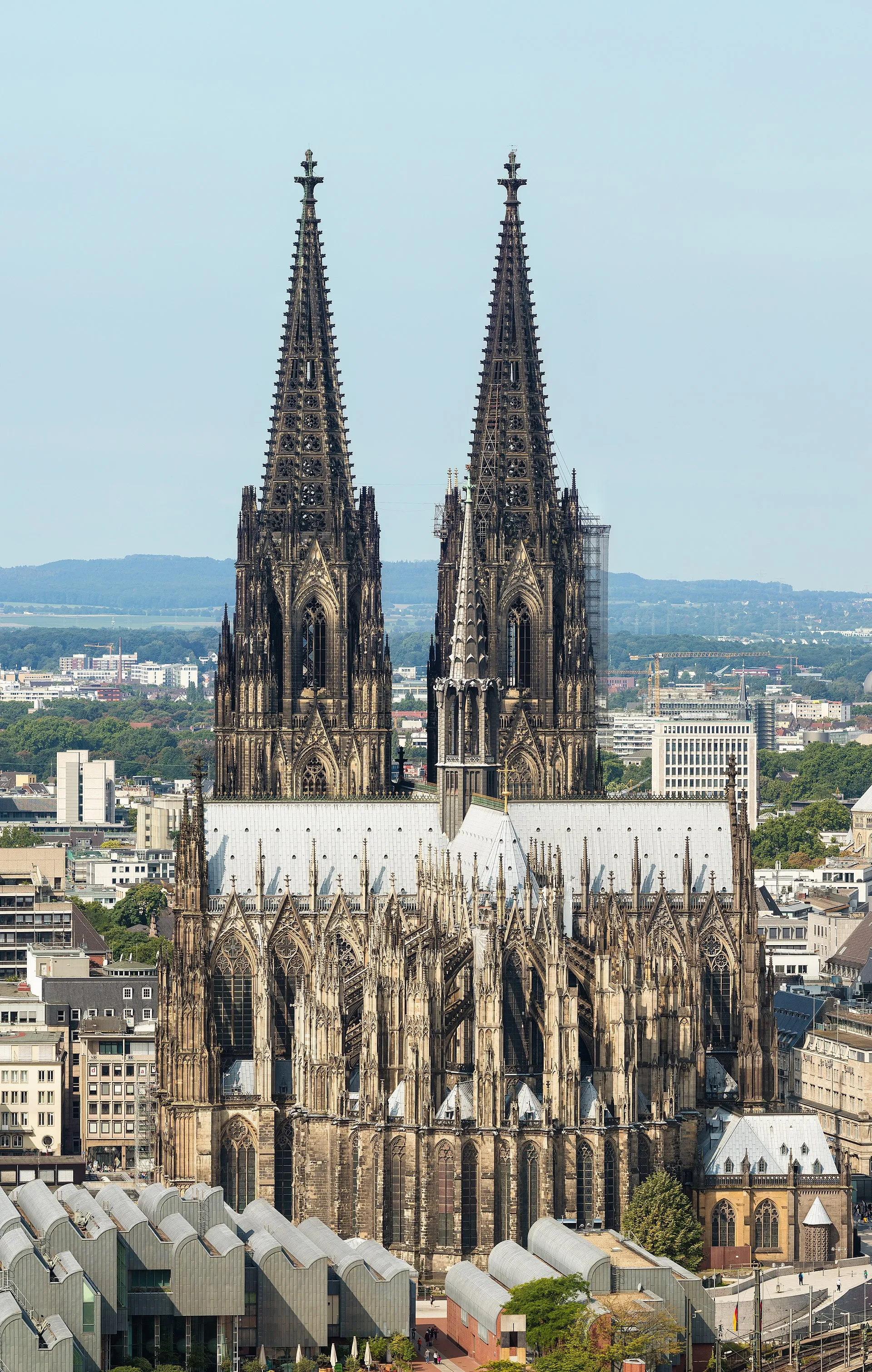
Cologne Cathedral
Construction began in 1248 to house the Shrine of the Three Kings, then stalled for 300 years before finally finishing in 1880 following the original medieval plans. Its twin spires reach 157 metres, and the 24-tonne bell nicknamed 'Dicke Pitter' still rings across the city today.
-
02
Museum Ludwig
When Peter and Irene Ludwig donated roughly 350 works to Cologne in 1976, the city gained not only the world's third-largest Picasso collection but also the largest Pop Art collection outside the United States. The sawtooth zinc roofs are hard to miss next to the cathedral.
-
03
Hohenzollern Bridge
Kaiser Wilhelm II inaugurated this railway bridge in 1911, German forces blew it up in March 1945 to slow the Allied advance, and it was rebuilt in time to reopen in 1948. Today more than 1,200 trains cross it daily, and the railings are thick with padlocks left by visitors from around the world.
-
04
Roman-Germanic Museum
The entire museum was built around a 74-square-metre Dionysus mosaic uncovered in 1941 when workers were digging an air-raid shelter. It also holds the world's largest collection of Roman glass vessels, all from a city founded as a Roman colony in 50 AD.
-
05
Fragrance Museum Farina-Haus
Italian perfumer Johann Maria Farina invented Eau de Cologne here in 1709 and named it after his adopted city. The factory at Obenmarspforten has been in continuous operation since 1723, making it the world's oldest fragrance factory still running.
-
06
St. Ursula's Basilica
Beneath this 12th-century Romanesque basilica lies a 4th-century Roman cemetery, and inside the 'Golden Chamber' human bones are arranged into elaborate decorative patterns on the walls, an ossuary unlike almost anything else in Germany. The building is tied to the legend of Saint Ursula and her 11,000 companions martyred in Cologne.
-
07
Melaten Cemetery
Before it became Cologne's main burial ground in 1810, this site was a medieval leprosy hospital, an execution ground where two Protestants were burned for their faith in 1529, and later a place where over 30 women and girls were killed in witch hunts. Today its 435,000 square metres of graves double as a listed ecological haven.
-
08
62 more places to discover
In the Parroo app
Good to know
69 researched places, from the Cologne Cathedral and the Roman-Germanic Museum to lesser-known spots like the Melaten Cemetery. Each one has a short summary, a full article, and a ~3-minute audio story.
Yes. Every place has a ~3-minute audio story, written from the perspective of a guide standing next to you and produced with premium narration, not the article read aloud.
German, English, and French. Pick whichever you'd rather read or listen in.
No booking, no signup. It's a self-guided walk you start whenever you like. You do need a connection for now to stream the audio and load articles; offline support is something we're still building.
A one-time €4.99 for the whole city, no subscription and no recurring cost. You buy Cologne once and keep access to all 69 places with text and audio.
Open this city in Parroo
Get the full articles, audio stories, and map for this city in the Parroo app. One payment per geography. Yours to keep.
Updated: 2026-09-25