
Coverage Germany
Audio Guide Aachen
app, one-time €4.99
Aachen sits at the heart of Europe where Germany, Belgium, and the Netherlands meet, and its history runs deeper than almost anywhere on the continent. Charlemagne chose this city as the seat of his empire, and the cathedral he built between 795 and 803 AD still stands, along with the Gothic town hall raised on the very foundations of his palace. The thermal springs that drew the Romans and Charlemagne himself still flow here today.
34+ researched places in the app
Yes. Parroo is a self-guided audio guide for Aachen: 34 researched places, from Aachen Cathedral to Aachen Town Hall and Elise Fountain, each with a short summary, a full article, and a roughly three-minute audio story in German, English, and French. Buy once, no subscription, no booking. Start whenever you like.
Audio sample: Aachen Cathedral
Aachen
Places researched in this city
A selection of the 34 places we've researched in this city. The full set is in the Parroo app.
- Carolingian cathedral
- Medieval gates
- Historic fountains
- Thermal spa heritage
- Contemporary art museum
-
01
Aachen Cathedral
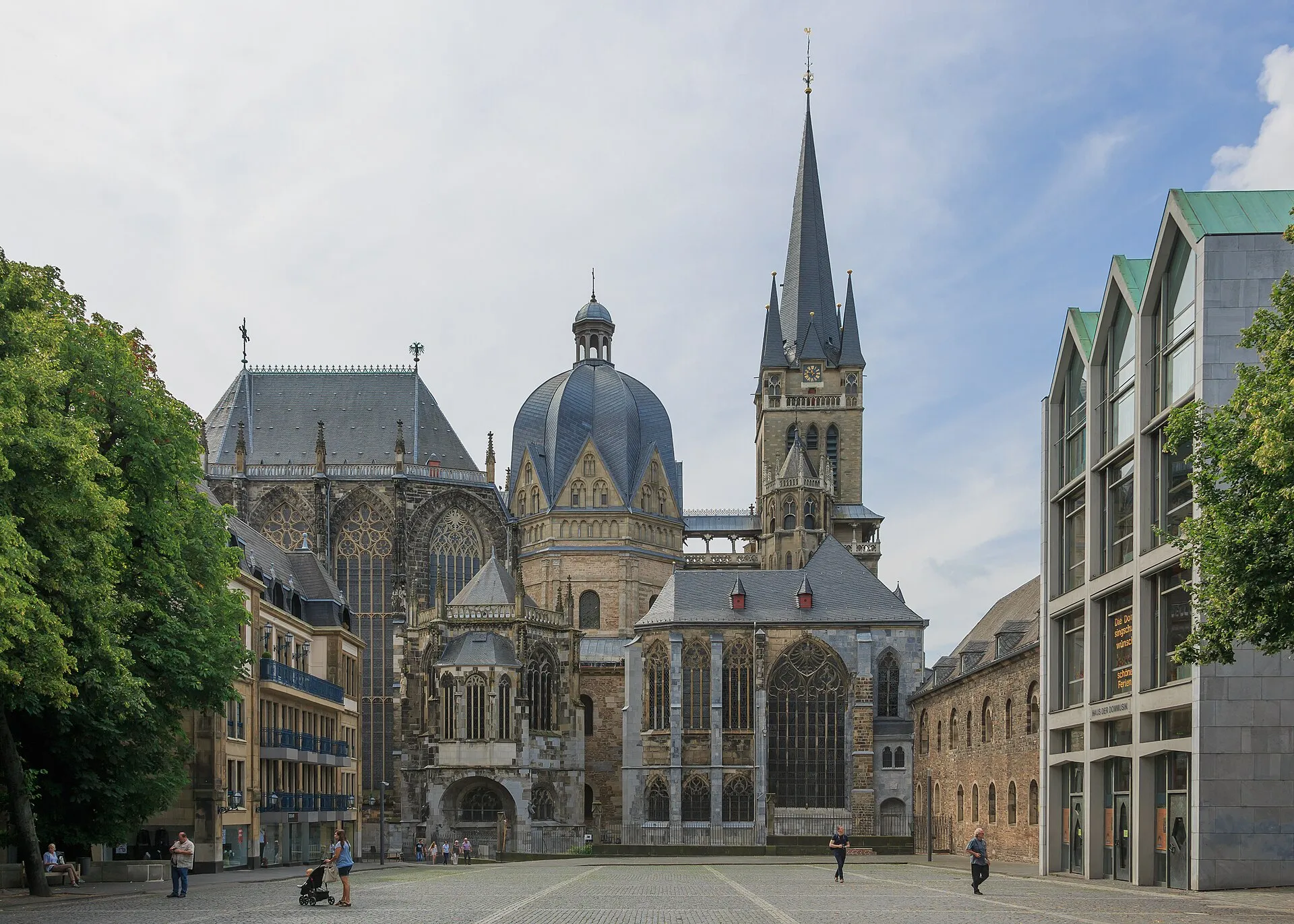
Thirty-one German kings were crowned here between 936 and 1531, making this octagonal Carolingian chapel the most important coronation church in the medieval German world. Charlemagne ordered its construction between 795 and 803 AD, and he was buried within its walls in 814.
-
02
Aachen Town Hall
Built between 1330 and 1349 directly on top of Charlemagne's royal hall, the town hall hosted coronation banquets for the Holy Roman Empire and today houses replicas of the imperial regalia. The Granus Tower embedded in its wall is even older, dating to around 788 AD.
-
03
Elise Fountain
Designed by Karl Friedrich Schinkel and built between 1822 and 1827, this neoclassical pavilion marks a spring tradition stretching back to Roman times. You can still drink the sulfurous thermal water at the tap inside.
-
04
Marching Gate
One of only two surviving city gates from Aachen's medieval fortifications, this double-towered gatehouse was built between 1257 and 1300 and served for centuries as the city's main armory. At 23.8 meters wide, it remains one of the most imposing medieval gates in Western Europe.
-
05
Lousberg
Aachen's highest city-center hill was already a busy industrial site in the Neolithic period, around 3500 to 3000 BC, when people quarried flint here and distributed axe blanks across the region. The Romans later mined its limestone for their buildings, and in 1807 it became a public park.
-
06
Bahkauv Fountain
This bronze sculpture commemorates a local legend about a monstrous calf-like creature that would leap onto the backs of drunk men stumbling home through Aachen's old town at night. The original 1904 fountain was melted down during World War II; the current version by Kurt-Wolf von Borries dates to 1967.
-
07
Three-Country Corner
From 1816 to 1919, this hilltop near Aachen was actually a four-country point, because a small neutral territory called Moresnet existed in the gap between the other three nations. After World War I, Belgium absorbed Moresnet, and the spot became the tri-border it is today, sitting on the Vaalserberg, the highest point in the Netherlands at 323 meters.
-
08
27 more places to discover
In the Parroo app
Good to know
34 researched places, from Aachen Cathedral and the Town Hall to lesser-known spots like the Bahkauv Fountain. Each one has a short summary, a full article, and a ~3-minute audio story.
Yes. Every place has a ~3-minute audio story, written from the perspective of a guide standing next to you and produced with premium narration, not the article read aloud.
German, English, and French. Pick whichever you'd rather read or listen in.
No booking, no signup. It's a self-guided walk you start whenever you like. You do need a connection for now to stream the audio and load articles; offline support is something we're still building.
A one-time €4.99 for the whole city, no subscription and no recurring cost. You buy Aachen once and keep access to all 34 places with text and audio.
Open this city in Parroo
Get the full articles, audio stories, and map for this city in the Parroo app. One payment per geography. Yours to keep.
Updated: 2026-09-25