
Coverage Germany
Audio Guide Weimar
app, one-time €4.99
Weimar punches well above its size: a small Thuringian city that gave the world Goethe, Schiller, the Bauhaus, and Germany's first democratic constitution. Its historic core is a UNESCO World Heritage Site, and the Duchess Anna Amalia Library once lost 50,000 books to fire yet still holds the world's largest Faust collection.
46+ researched places in the app
Yes. Parroo is a self-guided audio guide for Weimar: 46 researched places, from Goethe National Museum to Duchess Anna Amalia Library and Bauhaus Museum Weimar, each with a short summary, a full article, and a roughly three-minute audio story in German, English, and French. Buy once, no subscription, no booking. Start whenever you like.
Audio sample: Goethe National Museum
Weimar
Places researched in this city
A selection of the 46 places we've researched in this city. The full set is in the Parroo app.
- UNESCO palaces and parks
- Classical poets' houses
- Bauhaus architecture
- Historic churches
- Princely crypts
- Democratic history
-
01
Goethe National Museum
Goethe lived in this Baroque house from 1782 until his death in 1832, nearly 50 years in the same rooms, and left behind 2,000 drawings alongside his literary and scientific collections. It became Germany's first major writer's house museum in 1885, after the death of his last grandson.
-
02
Duchess Anna Amalia Library
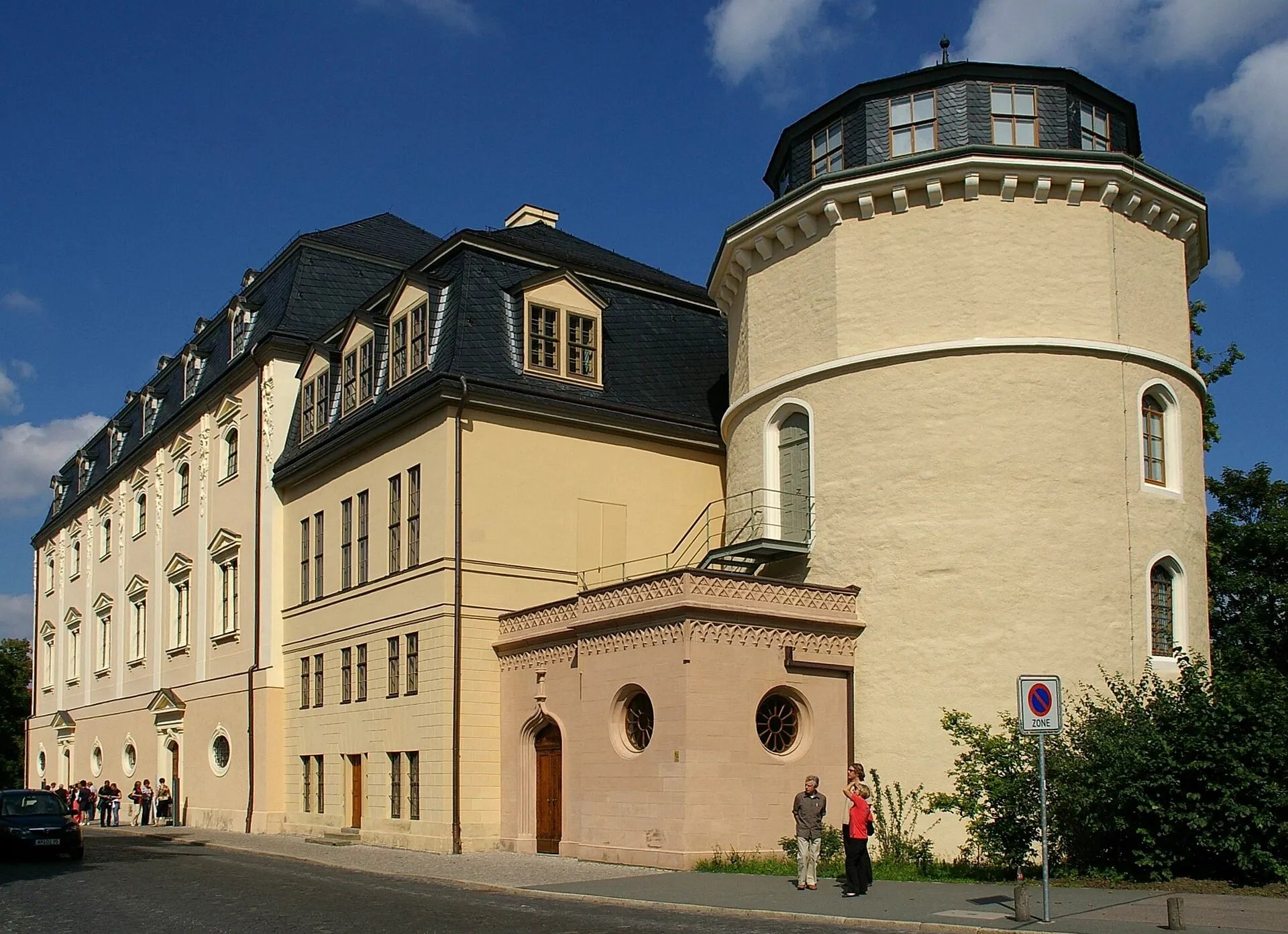
In 2004 a fire destroyed 50,000 volumes in this Renaissance palace turned Rococo library, yet the collection of around one million items, including the world's largest Faust archive, survived largely intact thanks to a human chain of rescuers. It reopened fully in 2007 and has been a UNESCO World Heritage Site since 1998.
-
03
Bauhaus Museum Weimar
The world's oldest Bauhaus collection, assembled from the very beginning by Walter Gropius, is now housed in a 27-million-euro minimalist cube that opened on the movement's 100th anniversary in 2019. Over 13,000 objects trace how a school in this small city rewired modern design.
-
04
Goethe and Schiller Monument
Ernst Rietschel's 1857 bronze double portrait shows Goethe placing a laurel wreath in Schiller's hand, a deliberate statement of equal literary standing between the two friends. It stands in front of the very theatre where the Weimar Constitution was adopted in 1919.
-
05
Buchenwald Memorial
Just a few kilometres from Weimar's classical townscape, the Ettersberg hill held one of the largest Nazi concentration camps on German soil, incarcerating around 280,000 people from over 50 nations between 1937 and 1945. After liberation, Allied forces required residents of Weimar to walk up and see it for themselves.
-
06
Russian Orthodox Chapel
When Grand Duchess Maria Pavlovna requested to be buried in Russian soil, earth from near Saint Petersburg was physically transported to Weimar and formed into a mound beneath this neo-Byzantine chapel, built in the Historic Cemetery between 1860 and 1862. An underground passage connects it directly to the Princely Crypt where Goethe and Schiller lie.
-
07
German Bee Museum
Tucked inside a former inn dating to 1677 in Oberweimar, this is Germany's oldest bee museum, founded in 1907, and it holds the only surviving wax hammer from 1637 alongside the world's largest collection of figured hive sculptures. Most visitors to Weimar never find it.
-
08
39 more places to discover
In the Parroo app
Good to know
46 researched places, from the Goethe National Museum and the Duchess Anna Amalia Library to lesser-known spots like the German Bee Museum. Each one has a short summary, a full article, and a ~3-minute audio story.
Yes. Every place has a ~3-minute audio story, written from the perspective of a guide standing next to you and produced with premium narration, not the article read aloud.
German, English, and French. Pick whichever you'd rather read or listen in.
No booking, no signup. It's a self-guided walk you start whenever you like. You do need a connection for now to stream the audio and load articles; offline support is something we're still building.
A one-time €4.99 for the whole city, no subscription and no recurring cost. You buy Weimar once and keep access to all 46 places with text and audio.
Open this city in Parroo
Get the full articles, audio stories, and map for this city in the Parroo app. One payment per geography. Yours to keep.
Updated: 2026-09-25