
Coverage Germany
Audio Guide Erfurt
app, one-time €4.99
Erfurt is one of Germany's best-preserved medieval city centers, a place where a bridge lined with lived-in half-timbered houses still functions as a shopping street and a bell cast in 1497 still swings freely above the largest cathedral square in the country. The city shaped Martin Luther, produced Europe's oldest surviving synagogue, and hosted Napoleon's Congress of Princes, all within a few minutes' walk of each other.
38+ researched places in the app
Yes. Parroo is a self-guided audio guide for Erfurt: 38 researched places, from Merchants' Bridge to Cathedral of St. Mary and Old Synagogue, each with a short summary, a full article, and a roughly three-minute audio story in German, English, and French. Buy once, no subscription, no booking. Start whenever you like.
Audio sample: Merchants' Bridge
Erfurt
Places researched in this city
A selection of the 38 places we've researched in this city. The full set is in the Parroo app.
- Medieval bridge
- Gothic cathedral
- Baroque fortress
- Jewish heritage
- Reformation history
- Renaissance squares
-
01
Merchants' Bridge
The Krämerbrücke is the longest bridge in Europe that has been continuously built over with inhabited houses: 32 half-timbered structures sit on a 125-metre stone span, rebuilt after a fire in 1325 on the site of a wooden bridge first mentioned in 1117. Today it still functions as a street of shops, galleries, and apartments.
-
02
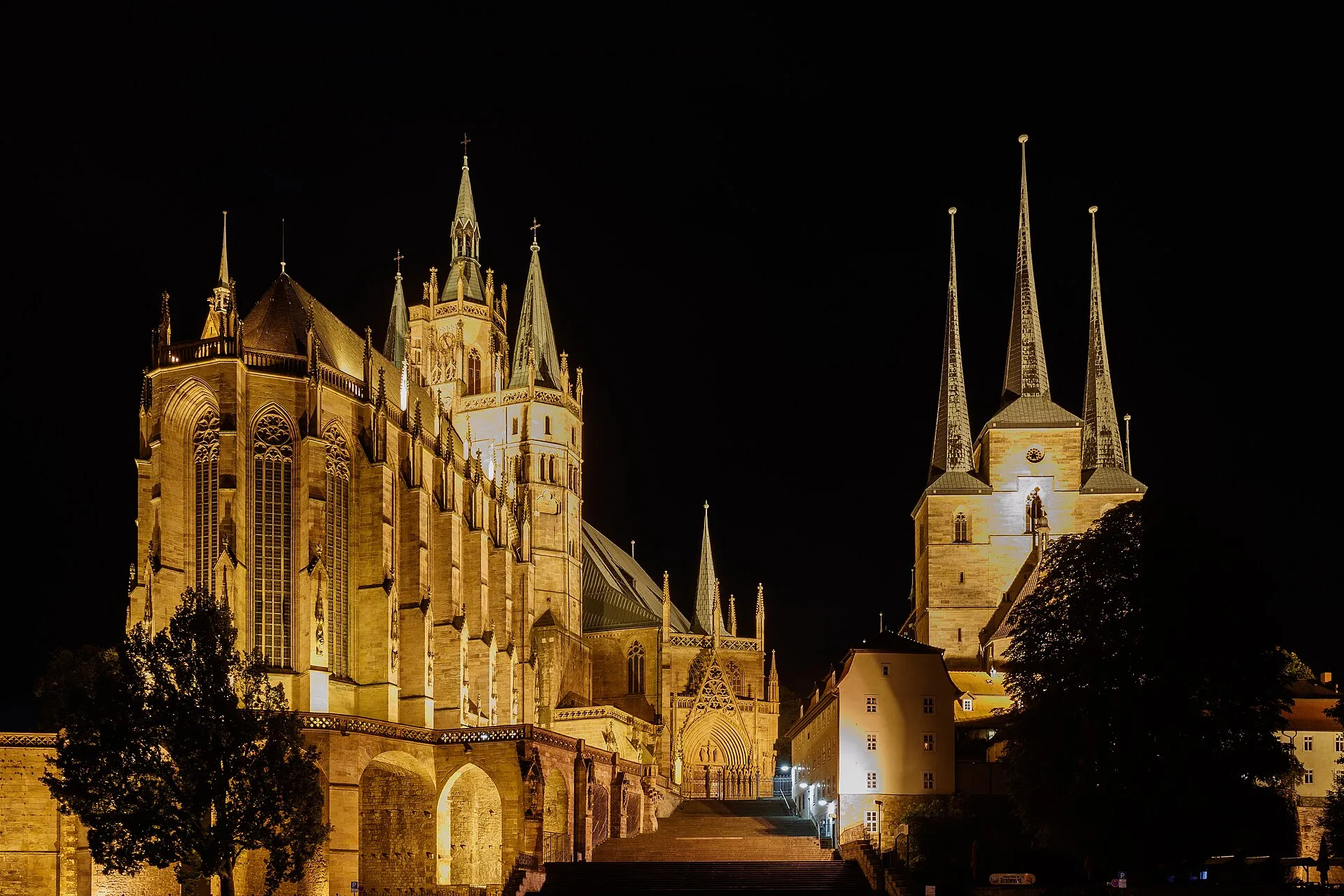
Cathedral of St. Mary
The Maria Gloriosa bell hanging inside this cathedral, cast in 1497, is the largest free-swinging medieval bell in the world, weighing 11,450 kg. It was also here, on the broad Cathedral Square, that Martin Luther was ordained as a priest in 1507.
-
03
Old Synagogue
Built around 1100 and preserved to roof level, the Alte Synagoge is the oldest fully intact synagogue building in Central Europe, and it survived centuries only because it was repurposed as a warehouse and dance hall after the 1349 pogrom. It became a UNESCO World Heritage site in 2023 and now houses the Erfurt Treasure, a remarkable collection of medieval Jewish artifacts.
-
04
Petersberg Citadel
Before this star-shaped baroque fortress rose between 1665 and 1702, the hill held Thuringia's largest Romanesque monastic church, which was demolished to make way for it. The Electorate of Mainz built the 36-hectare citadel to keep Protestant Erfurt in check, and its walls still reach up to 23 metres high.
-
05
Evangelical Augustinian Monastery
Martin Luther entered this Gothic monastery on 17 July 1505 and lived here until 1511, the years in which his theological thinking took shape. He celebrated his first Mass within its walls in 1507, making it arguably the single building most closely tied to the origins of the Reformation.
-
06
Fish Market
The neo-Gothic town hall that anchors this square was built between 1870 and 1874, but the square itself has been a commercial and civic centre since the 13th century, and the Renaissance patrician houses surrounding it date to the 1580s. A statue known as the Römer, placed here in 1591, originally symbolised the defence of civic freedoms.
-
07
Molsdorf Castle
Known locally as the Thuringian Versailles, this Baroque pleasure palace was transformed between 1734 and 1740 by Reichsgraf Gustav Adolf von Gotter, whose personal motto was 'Vive la joie.' The count used it for famously lavish gatherings, and even the original moated castle beneath it dates back to the 13th century.
-
08
31 more places to discover
In the Parroo app
Good to know
38 researched places, from the Merchants' Bridge and the Cathedral of St. Mary to lesser-known spots like Molsdorf Castle. Each one has a short summary, a full article, and a ~3-minute audio story.
Yes. Every place has a ~3-minute audio story, written from the perspective of a guide standing next to you and produced with premium narration, not the article read aloud.
German, English, and French. Pick whichever you'd rather read or listen in.
No booking, no signup. It's a self-guided walk you start whenever you like. You do need a connection for now to stream the audio and load articles; offline support is something we're still building.
A one-time €4.99 for the whole city, no subscription and no recurring cost. You buy Erfurt once and keep access to all 38 places with text and audio.
Open this city in Parroo
Get the full articles, audio stories, and map for this city in the Parroo app. One payment per geography. Yours to keep.
Updated: 2026-09-25