
Coverage Germany
Audio Guide Leipzig
app, one-time €4.99
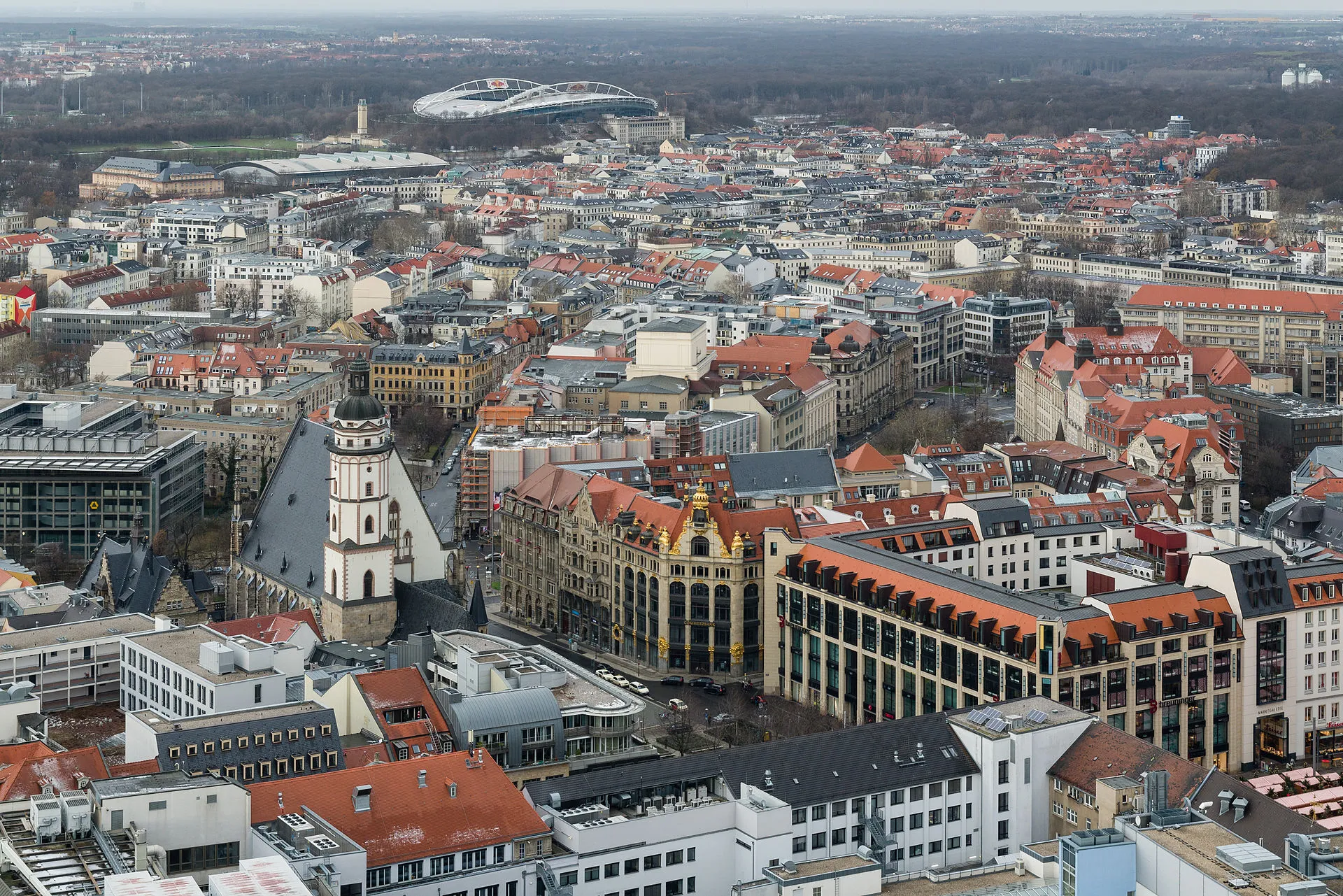
Leipzig is a city shaped by music, revolutions, and trade. Johann Sebastian Bach composed here, Richard Wagner was born on its streets, and in 1989 the Monday Demonstrations at St. Nicholas Church helped bring down the Berlin Wall without a shot fired. Few cities of its size carry so much history in such a compact center.
69+ researched places in the app
Yes. Parroo is a self-guided audio guide for Leipzig: 69 researched places, from St. Nicholas Church to Monument to the Battle of the Nations and St. Thomas Church, each with a short summary, a full article, and a roughly three-minute audio story in German, English, and French. Buy once, no subscription, no booking. Start whenever you like.
Audio sample: St. Nicholas Church
Leipzig
Places researched in this city
A selection of the 69 places we've researched in this city. The full set is in the Parroo app.
- Gothic churches
- Renaissance squares
- Napoleonic monuments
- Concert halls
- Underground cellars
- Soviet-era towers
-
01
St. Nicholas Church
The Monday Demonstrators who gathered here in 1989 and helped end East German rule were doing so in a church founded between 1165 and 1180, named after the patron saint of merchants because Leipzig was, above all, a trading city. Seating over 1,400 people, it remains the largest church in Leipzig.
-
02
Monument to the Battle of the Nations
Built on a former landfill, this 91-meter granite-porphyry colossus was constructed from 26,500 blocks and inaugurated in 1913, exactly a century after the battle that involved over 500,000 soldiers and was the largest in human history up to that point. The observation platform at the top rewards the climb.
-
03
St. Thomas Church
Johann Sebastian Bach served as Thomaskantor in this Late Gothic church and premiered many of his major works here. The oldest bell in the tower dates to 1477, and the Thomanerchor boys' choir has sung continuously since 1212.
-
04
Old Town Hall
Built in a reported eight months in 1556 under mayor Hieronymus Lotter, this Renaissance structure is one of Germany's most significant secular buildings of its era. In 1723, Johann Sebastian Bach signed his employment contract here, setting up one of the most consequential appointments in music history.
-
05
Auerbach's Cellar
Goethe studied in Leipzig between 1765 and 1768, visited this wine cellar, and later immortalized it in Faust I, making it one of the few real locations to appear in a canonical work of world literature. The cellar itself dates to 1525, tucked beneath the Mädler Passage.
-
06
Barefoot Alley
In the 18th century, a coffee-house owner named Johann Georg Schrepfer ran séances in this alley, projecting ghost images with a magic lantern onto smoke screens and charging audiences to commune with the dead, until the trick was finally exposed. The alley itself was named centuries earlier for Franciscan monks who walked its cobblestones barefoot.
-
07
Schiller House
Friedrich Schiller spent the summer of 1785 in this 1717 farmhouse, the oldest preserved farmhouse in Leipzig, writing parts of Don Carlos and drafting the text that Beethoven would later set as the Ode to Joy. It was rediscovered as Schiller's workplace only in 1841.
-
08
62 more places to discover
In the Parroo app
Good to know
69 researched places, from the Monument to the Battle of the Nations and St. Nicholas Church to lesser-known spots like Barefoot Alley. Each one has a short summary, a full article, and a ~3-minute audio story.
Yes. Every place has a ~3-minute audio story, written from the perspective of a guide standing next to you and produced with premium narration, not the article read aloud.
German, English, and French. Pick whichever you'd rather read or listen in.
No booking, no signup. It's a self-guided walk you start whenever you like. You do need a connection for now to stream the audio and load articles; offline support is something we're still building.
A one-time €4.99 for the whole city, no subscription and no recurring cost. You buy Leipzig once and keep access to all 69 places with text and audio.
Nearby cities
Open this city in Parroo
Get the full articles, audio stories, and map for this city in the Parroo app. One payment per geography. Yours to keep.
Updated: 2026-09-25