
Coverage Germany
Audio Guide Münster
app, one-time €4.99
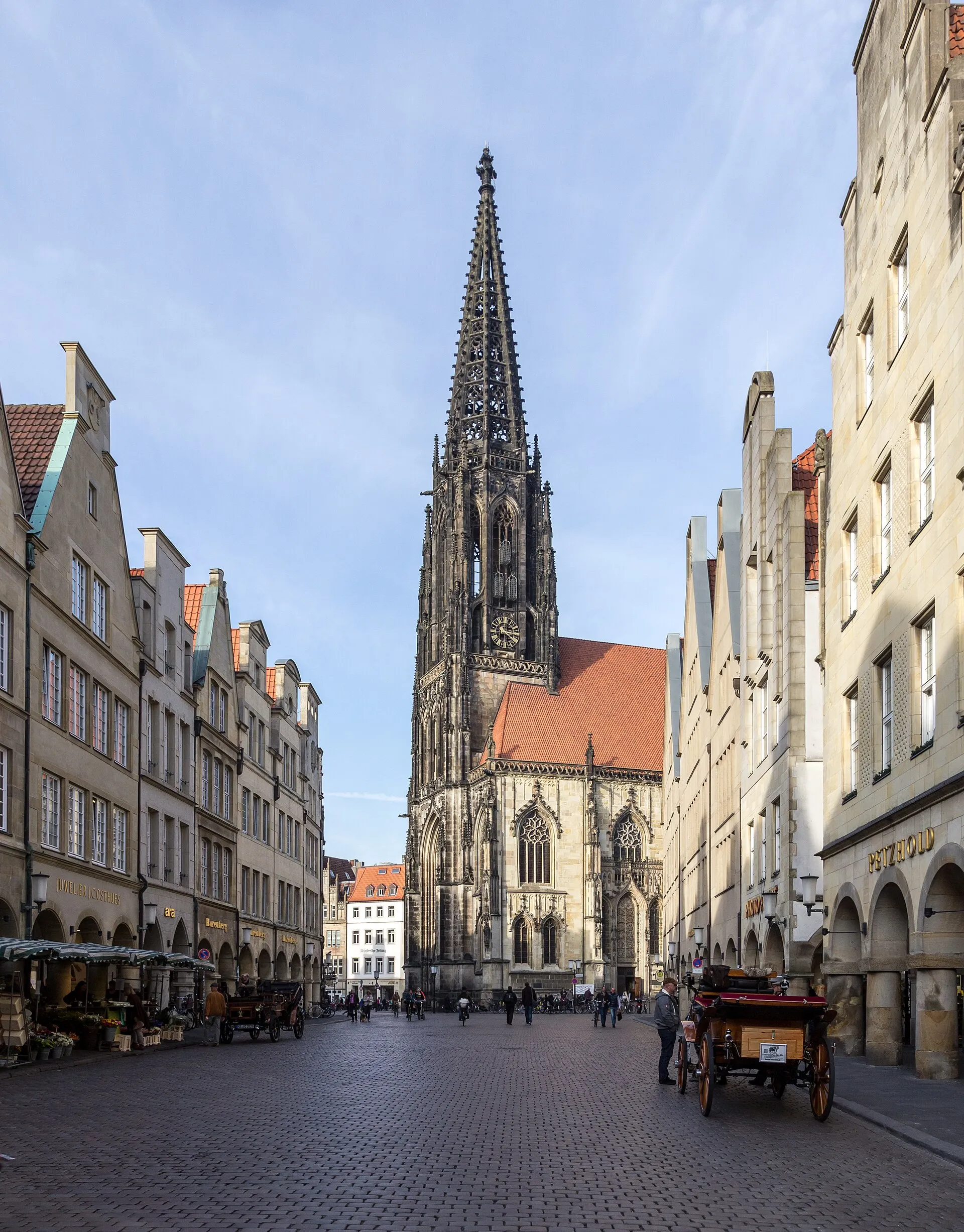
Münster is a cathedral city in Westphalia with a medieval core rebuilt almost entirely after World War II, a massive cycling culture, and a skyline still defined by Gothic spires and Baroque palaces. The iron cages hanging from St. Lamberti's tower have been there since 1536, a lasting reminder of the city's most violent chapter.
33+ researched places in the app
Yes. Parroo is a self-guided audio guide for Münster: 33 researched places, from St. Lamberti to Münster Castle and Cathedral Square, each with a short summary, a full article, and a roughly three-minute audio story in German, English, and French. Buy once, no subscription, no booking. Start whenever you like.
Audio sample: St. Lamberti
Münster
Places researched in this city
A selection of the 33 places we've researched in this city. The full set is in the Parroo app.
- Gothic churches
- Baroque palaces
- Medieval fortifications
- Lakeside parks
- Contemporary art spaces
-
01
St. Lamberti
Three iron cages have hung from St. Lamberti's 90.5-metre tower since 1536, displaying the corpses of the Anabaptist leaders executed after the Münster Rebellion. The late Gothic church, financed by local merchants and built between 1375 and 1525, keeps a tower watchman tradition alive to this day.
-
02
Münster Castle
Johann Conrad Schlaun built this Baroque palace between 1767 and 1787 for the last prince-bishops of Münster, with a 91-metre facade of red brick and Baumberger sandstone. After heavy wartime damage it was restored and now serves as the main building of the University of Münster.
-
03
Cathedral Square
The Domplatz has been Münster's civic and religious centre since the Middle Ages, when it formed the heart of the bishop's own jurisdiction within the city. Today it hosts a twice-weekly market flanked by the St. Paulus-Dom, the Fürstenberghaus, and the Bishop's Palace.
-
04
LWL Museum for Art and Culture
Founded in 1908 on the Domplatz, this museum covers more than 1,000 years of art across 7,500 square metres, combining the original Neo-Renaissance building with a 2014 extension by Staab Architekten. Its collection draws on the former holdings of both the Westphalian Art Association and the Association for the History and Antiquity of Westphalia.
-
05
Aasee
This 40-hectare artificial lake was first proposed by zoology professor Hermann Landois in 1888, took until 1934 to complete, and was later expanded in the 1970s to accommodate the All Weather Zoo. The surrounding park was voted the most beautiful in Europe in 2009.
-
06
Buddenturm
Built around 1150, the Buddenturm is the oldest surviving piece of Münster's city fortifications, and over its nine centuries it has served as a defensive tower, a prison, a gunpowder magazine, and a water tower. It was spared during the demolition of the city walls in the 1760s because its water-tower function was still needed.
-
07
Zwinger Münster
Erected around 1528 at the point where the Aa river left the city, the Zwinger was converted into a memorial for victims of Nazi violence in 1997, with a sound sculpture by Rebecca Horn installed inside. Its walls are 1.95 metres thick, a detail that later made it useful as a gunpowder mill and, during the Nazi period, as a detention site.
-
08
26 more places to discover
In the Parroo app
Good to know
33 researched places, from St. Lamberti and Münster Castle to lesser-known spots like the Buddenturm. Each one has a short summary, a full article, and a ~3-minute audio story.
Yes. Every place has a ~3-minute audio story, written from the perspective of a guide standing next to you and produced with premium narration, not the article read aloud.
German, English, and French. Pick whichever you'd rather read or listen in.
No booking, no signup. It's a self-guided walk you start whenever you like. You do need a connection for now to stream the audio and load articles; offline support is something we're still building.
A one-time €4.99 for the whole city, no subscription and no recurring cost. You buy Münster once and keep access to all 33 places with text and audio.
Open this city in Parroo
Get the full articles, audio stories, and map for this city in the Parroo app. One payment per geography. Yours to keep.
Updated: 2026-09-25