
Coverage Germany
Audio Guide Greifswald
app, one-time €4.99
Greifswald is a compact Hanseatic university town on Germany's Baltic coast, shaped by seven centuries of brick Gothic architecture and an outsized artistic legacy. Romantic painter Caspar David Friedrich was born and baptized here, and the ruins he immortalised on canvas still stand on the edge of town. Three medieval parish churches, a harbour full of historic wooden vessels, and a university founded in 1456 give the city a density of history that belies its modest size.
21+ researched places in the app
Yes. Parroo is a self-guided audio guide for Greifswald: 21 researched places, from St. Nicholas Cathedral to Eldena Monastery Ruins and Marketplace, each with a short summary, a full article, and a roughly three-minute audio story in German, English, and French. Buy once, no subscription, no booking. Start whenever you like.
Audio sample: St. Nicholas Cathedral
Greifswald
Places researched in this city
A selection of the 21 places we've researched in this city. The full set is in the Parroo app.
- Brick Gothic churches
- Medieval ruins
- Museum harbour
- Historic university
- Fishing village
- Green promenades
-
01
St. Nicholas Cathedral
Caspar David Friedrich was baptized in this cathedral in 1774, and when the University of Greifswald was founded in 1456, the ceremony took place inside these walls. The 100-metre tower of the Gothic brick structure has watched over the city for more than seven centuries.
-
02
Eldena Monastery Ruins
Founded in 1199 by monks who fled the destruction of Dargun, these late-Romanesque and early Gothic ruins became one of Caspar David Friedrich's most painted subjects, turning a crumbling Cistercian church into an enduring symbol of Romantic melancholy. Pope Innocent III confirmed the monastery's land holdings as early as 1204.
-
03
Marketplace
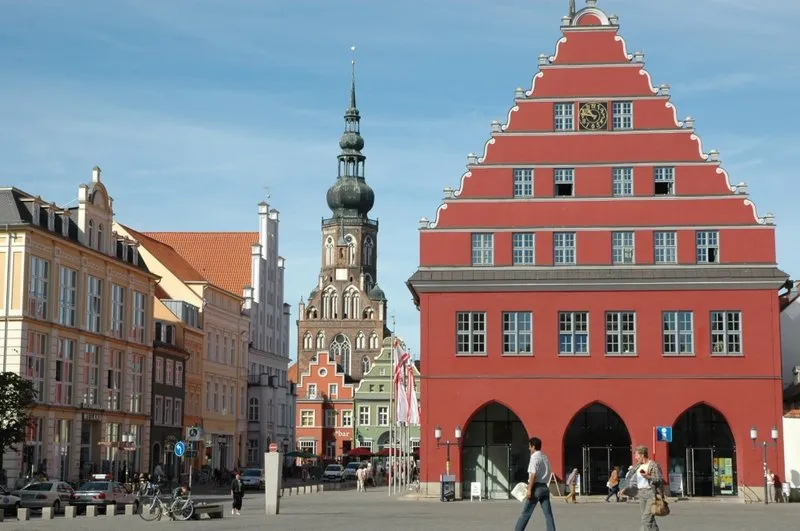
During his honeymoon in 1818, Caspar David Friedrich painted this 11,000-square-metre square as a watercolour gift for his brother, a work now held in the Pomeranian State Museum. The ochre-red town hall at its edge was first mentioned in 1349 and rebuilt twice after city fires.
-
04
University of Greifswald
Founded on 17 October 1456 with backing from Emperor Frederick III and Pope Callixtus III, this is one of the oldest universities in the Baltic Sea region. Academic teaching here actually began two decades earlier in 1436, when the University of Rostock temporarily relocated due to an imperial ban.
-
05
Museum Harbour at Ryck
More than 50 historic vessels, including a Zeesboot from 1880, are moored along the Ryck, kept afloat by volunteers who began preserving fishing traditions during the GDR era in the 1980s. A restored 13th-century tower, the Fangenturm, now serves as the harbourmaster's office.
-
06
Wieck Drawbridge
Built in 1887 on Dutch engineering principles, this 55-metre wooden double bascule bridge is still raised by hand whenever a sailing vessel needs to pass through to the harbour. Before it was built, crossing the Ryck relied entirely on ferries.
-
07
St. Spiritus
Founded in 1262 as a municipal hospital supported by Duke Wartislaw III with annual donations of rye and malt, the chapel inside this complex later served stints as a metal foundry and, from 1748, as a bakery before becoming a socio-cultural centre after 1990. The North German Brick Gothic church walls still partially stand today.
-
08
14 more places to discover
In the Parroo app
Good to know
21 researched places, from St. Nicholas Cathedral and the Eldena Monastery Ruins to lesser-known spots like St. Spiritus. Each one has a short summary, a full article, and a ~3-minute audio story.
Yes. Every place has a ~3-minute audio story, written from the perspective of a guide standing next to you and produced with premium narration, not the article read aloud.
German, English, and French. Pick whichever you'd rather read or listen in.
No booking, no signup. It's a self-guided walk you start whenever you like. You do need a connection for now to stream the audio and load articles; offline support is something we're still building.
A one-time €4.99 for the whole city, no subscription and no recurring cost. You buy Greifswald once and keep access to all 21 places with text and audio.
Open this city in Parroo
Get the full articles, audio stories, and map for this city in the Parroo app. One payment per geography. Yours to keep.
Updated: 2026-09-25