
Coverage Germany
Audio Guide Dresden
app, one-time €4.99
Dresden earned the nickname 'Florence on the Elbe' through centuries of Saxon rulers filling it with Baroque palaces, world-class art collections, and a skyline that still stuns from the riverbank. The city was largely flattened in 1945, yet the painstaking reconstruction of landmarks like the Frauenkirche, rebuilt stone by stone using the original rubble, makes Dresden one of Europe's most compelling stories of loss and renewal.
63+ researched places in the app
Yes. Parroo is a self-guided audio guide for Dresden: 63 researched places, from Dresden Church of Our Lady to Zwinger and Semper Opera House, each with a short summary, a full article, and a roughly three-minute audio story in German, English, and French. Buy once, no subscription, no booking. Start whenever you like.
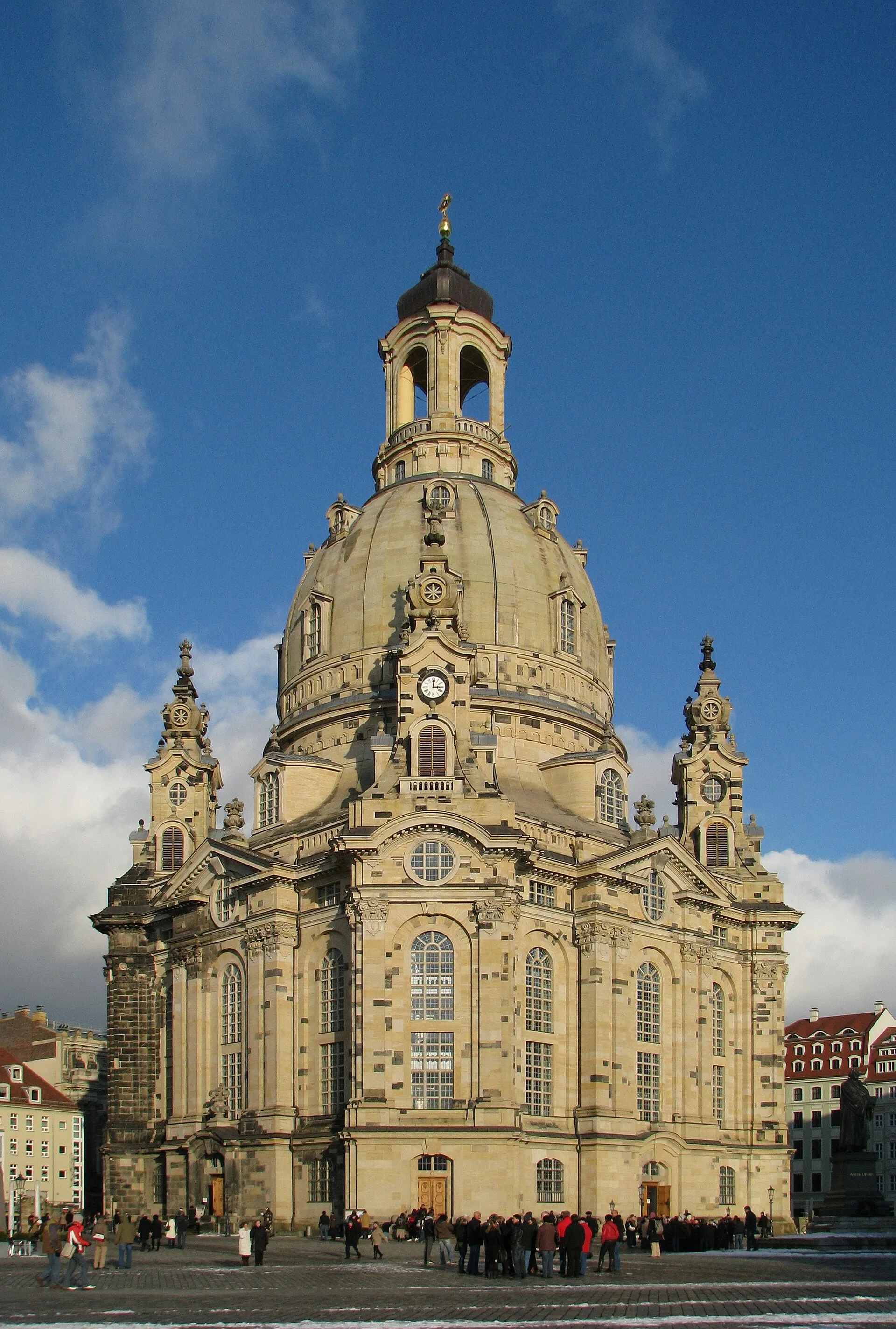
Audio sample: Dresden Church of Our Lady
Dresden
Places researched in this city
A selection of the 63 places we've researched in this city. The full set is in the Parroo app.
- Baroque palaces
- Art galleries
- Historic churches
- Riverside promenades
- Engineering marvels
-
01
Dresden Church of Our Lady
Reduced to rubble in 1945 and left as a war memorial for decades, the Frauenkirche was rebuilt stone by stone between 1994 and 2005 using the original plans and salvaged masonry, with a new cross crafted by a British goldsmith as a gesture of reconciliation. George Bähr's 91-metre sandstone dome is once again the centrepiece of Dresden's skyline.
-
02
Zwinger
Augustus the Strong commissioned this Baroque palace complex between 1709 and 1728 purely for court festivities, and architect Matthäus Daniel Pöppelmann filled the 204-by-116-metre courtyard with fountains, gates, and sculpted galleries that have no equal in Germany. Today it houses the Old Masters Picture Gallery and other major collections.
-
03
Semper Opera House
Wagner and Strauss both had major premieres here, yet the building itself burned down and was rebuilt twice; the current opera house reopened in 1985, forty years after bombs reduced it to a shell. Its curved Neo-Renaissance facade overlooking Theaterplatz remains the defining image of Dresden's old town.
-
04
Green Vault
Augustus the Strong opened this treasure chamber in 1723, filling nine rooms in the Dresden Royal Palace with gold, silver, and gemstone works by 220 jewelers, displayed without protective glass exactly as they were in the Baroque era. Among the pieces is a cherry stone carved with 185 faces, one of the most astonishing objects in any European museum.
-
05
Procession of Princes
The world's largest porcelain artwork stretches 102 metres along the wall of the Dresden Royal Palace: originally a sgraffito mural from the 1870s, it was replaced between 1904 and 1907 with roughly 23,000 Meissen porcelain tiles that survived the firebombing of 1945 almost unscathed. It depicts 35 Wettin rulers alongside courtiers, knights, and craftsmen.
-
06
Yenidze
A tobacco factory disguised as a mosque: built between 1907 and 1909, the owner designed this Moorish Revival building with a minaret-shaped chimney and a 20-metre glass dome specifically to market the exotic origins of his Oriental tobacco, and to get around zoning rules that banned factory chimneys in that part of the city. It now houses offices and a rooftop restaurant.
-
07
Pfunds Dairy
The Guinness Book of Records once named it the most beautiful dairy shop in the world, and a visit makes the claim hard to argue: every surface of this 1892 shop is covered in hand-painted neo-Renaissance tiles by Villeroy and Boch, depicting mythological scenes and floral motifs. It survived the 1945 bombing intact and was restored after reunification.
-
08
56 more places to discover
In the Parroo app
Good to know
63 researched places, from the Frauenkirche and the Zwinger to lesser-known spots like Pfunds Dairy. Each one has a short summary, a full article, and a ~3-minute audio story.
Yes. Every place has a ~3-minute audio story, written from the perspective of a guide standing next to you and produced with premium narration, not the article read aloud.
German, English, and French. Pick whichever you'd rather read or listen in.
No booking, no signup. It's a self-guided walk you start whenever you like. You do need a connection for now to stream the audio and load articles; offline support is something we're still building.
A one-time €4.99 for the whole city, no subscription and no recurring cost. You buy Dresden once and keep access to all 63 places with text and audio.
Nearby cities
Open this city in Parroo
Get the full articles, audio stories, and map for this city in the Parroo app. One payment per geography. Yours to keep.
Updated: 2026-09-25