
Coverage Germany
Audio Guide Potsdam
app, one-time €4.99
Potsdam is Prussia's showpiece city, where palaces, parks, and garden follies accumulate around every bend of the Havel River. Frederick the Great built his intimate retreat here in 1745, naming it Sanssouci, meaning without concerns, and generations of Prussian royals kept adding to the landscape ever since. The result is a UNESCO World Heritage ensemble unlike anywhere else in Germany.
52+ researched places in the app
Yes. Parroo is a self-guided audio guide for Potsdam: 52 researched places, from Sanssouci Palace to Cecilienhof Palace and New Palace, each with a short summary, a full article, and a roughly three-minute audio story in German, English, and French. Buy once, no subscription, no booking. Start whenever you like.
Audio sample: Sanssouci Palace
Potsdam
Places researched in this city
A selection of the 52 places we've researched in this city. The full set is in the Parroo app.
- Rococo palaces
- Baroque gardens
- Neoclassical churches
- Medieval gates
- Tudor Revival
- Film heritage
-
01
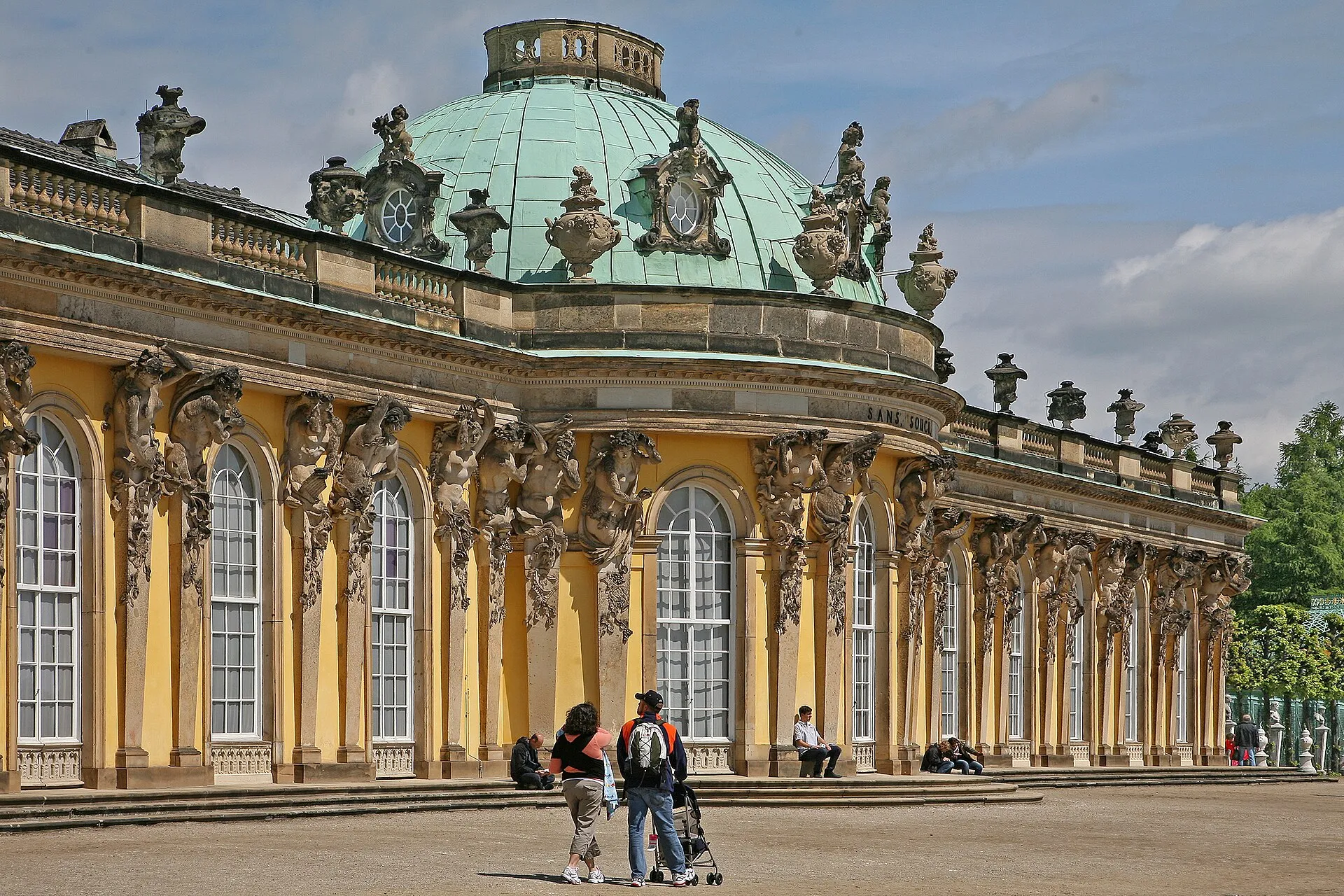
Sanssouci Palace
Frederick the Great named his summer retreat 'without concerns' and meant it literally: he designed the terraced vineyards himself in 1744 before a single stone of the palace was laid. The Rococo building that Georg Wenzeslaus von Knobelsdorff completed between 1745 and 1747 remains the most personal of all Prussian royal residences.
-
02
Cecilienhof Palace
The last palace the Hohenzollern dynasty ever built, finished in 1917 in Tudor Revival style, became the site where Allied leaders redrew the map of postwar Europe at the Potsdam Conference from 17 July to 2 August 1945. Its 55 chimneys and half-timbered facades look more like an English country house than a royal seat.
-
03
New Palace
Frederick the Great built this 220-metre Baroque showpiece between 1763 and 1769 not to live in, but to prove Prussia was still powerful after the ruinous Seven Years' War. He rarely stayed there himself; the palace's Grotto Hall, decorated with shells and minerals, was purely for impressing guests.
-
04
Nikolai Church
Karl Friedrich Schinkel's neoclassical design was considered too bold for Potsdam when work began in 1830, and the signature tambour dome was only added by his successors Ludwig Persius and Friedrich August Stüler between 1843 and 1850. That dome now rises 77 metres above the Old Market and defines the entire city skyline.
-
05
Dutch Quarter
King Frederick William I commissioned this neighbourhood between 1733 and 1742 specifically to attract Dutch craftsmen, but the Dutch never came in the numbers he hoped for. Architect Jan Bouman laid out 134 to 150 red-brick gabled houses that today form the largest coherent Dutch-style urban ensemble outside the Netherlands.
-
06
Einstein Tower
Erich Mendelsohn designed this curvilinear expressionist tower between 1920 and 1922 for a single purpose: to run experiments that would verify Einstein's theory of general relativity. The solar telescope inside still functions as a research facility, making it one of the few landmark buildings in the world still doing the scientific job it was built for.
-
07
Nauen Gate
Frederick II sketched the design for this gate himself in 1754, choosing a Gothic, medievalising style he personally disliked, because he wanted it to evoke antiquity. Completed by architect Johann Gottfried Büring in 1755, it is considered one of the earliest examples of Gothic Revival architecture on the European continent, predating the wider movement by roughly 20 years.
-
08
45 more places to discover
In the Parroo app
Good to know
52 researched places, from Sanssouci Palace and Cecilienhof Palace to lesser-known spots like the Einstein Tower. Each one has a short summary, a full article, and a ~3-minute audio story.
Yes. Every place has a ~3-minute audio story, written from the perspective of a guide standing next to you and produced with premium narration, not the article read aloud.
German, English, and French. Pick whichever you'd rather read or listen in.
No booking, no signup. It's a self-guided walk you start whenever you like. You do need a connection for now to stream the audio and load articles; offline support is something we're still building.
A one-time €4.99 for the whole city, no subscription and no recurring cost. You buy Potsdam once and keep access to all 52 places with text and audio.
Open this city in Parroo
Get the full articles, audio stories, and map for this city in the Parroo app. One payment per geography. Yours to keep.
Updated: 2026-09-25