
Coverage Germany
Audio Guide Nuremberg
app, one-time €4.99
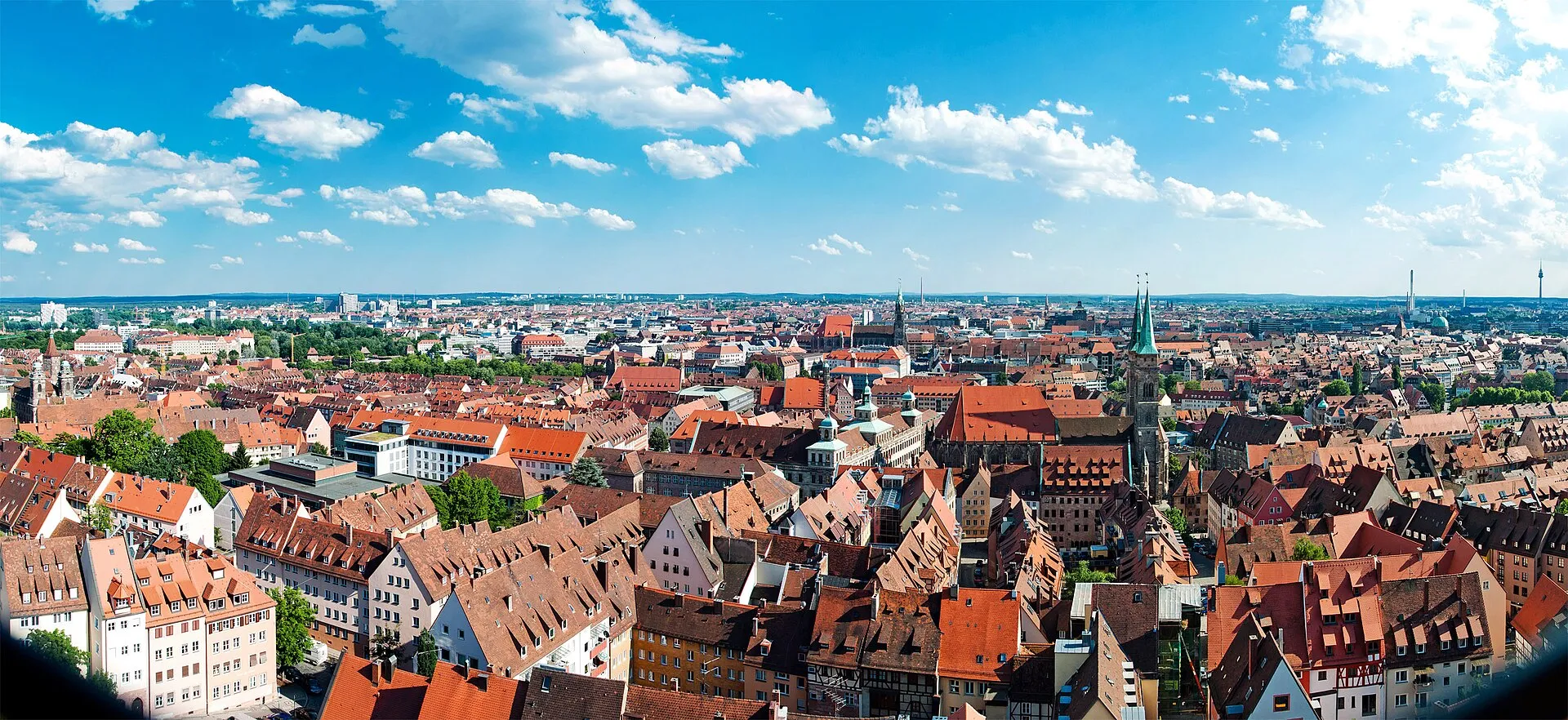
Nuremberg is a city where the Holy Roman Empire, the Renaissance, and the darkest chapter of the 20th century all left their mark within walking distance of each other. The Imperial Castle has loomed over the red-rooftop skyline since around 1000 AD, and beneath the hill, medieval lanes give way to Gothic churches, Albrecht Dürer's home, and the courtroom where Nazi leaders were tried. Few German cities pack this much layered history into so compact an old town.
62+ researched places in the app
Yes. Parroo is a self-guided audio guide for Nuremberg: 62 researched places, from Imperial Castle Nuremberg to St. Sebaldus Church and Germanic National Museum, each with a short summary, a full article, and a roughly three-minute audio story in German, English, and French. Buy once, no subscription, no booking. Start whenever you like.
Audio sample: Imperial Castle Nuremberg
Nuremberg
Places researched in this city
A selection of the 62 places we've researched in this city. The full set is in the Parroo app.
- Imperial castle
- Gothic churches
- Medieval streets
- Renaissance art
- War history
- Fountain sculpture
-
01
Imperial Castle Nuremberg
Every German king and emperor was expected to hold their first imperial diet here, making this sandstone fortress a de facto political capital of the Holy Roman Empire for centuries. The 41-metre Sinwell Tower and a double chapel survive from the Romanesque period, and a deep well cut through solid rock still draws water today.
-
02
St. Sebaldus Church
Nuremberg's oldest parish church holds a bronze shrine to Saint Sebaldus cast by Peter Vischer that took the Vischer workshop over eleven years to complete. The building itself traces the city's full architectural arc, from late Romanesque stonework begun around 1220 to a Gothic hall choir added in 1379.
-
03
Germanic National Museum
The largest cultural history museum in the German-speaking world grew from one baron's 1852 ambition to gather every source of German history under one roof, and now holds over 1.3 million objects including Martin Behaim's 1492 Erdapfel, the oldest surviving terrestrial globe. The outdoor 'Way of Human Rights' by Dani Karavan lines the approach with 27 concrete pillars inscribed with the Universal Declaration.
-
04
Albrecht Dürer House
Dürer bought this half-timbered merchant house in 1509 and lived here until his death in 1528, making it the only surviving 15th-century artist's home in Northern Europe. A previous owner, astronomer Bernard Walther, had already cut small windows into the roof to use the upper floors as an observatory before Dürer ever moved in.
-
05
Memorium Nuremberg Trials
Courtroom 600 in the Nuremberg Palace of Justice was adapted in 1945 to host the first international military tribunals in history, with a new simultaneous translation system installed because the proceedings ran in four languages at once. The courtroom still functions as a working court today, open to visitors when not in session.
-
06
Historic Art Bunker
The tunnels carved into the sandstone beneath Nuremberg Castle were medieval beer cellars for centuries before the city quietly converted them in 1940 into a climate-controlled vault for irreplaceable artworks, hiding Dürer paintings, Veit Stoss carvings, and the Imperial Regalia 24 metres underground during Allied air raids. The Zeiss planetarium projector from the city's demolished 1927 planetarium also survived the war here.
-
07
Chain Bridge (Kettensteg)
Built in just four months in 1824, this 68-metre pedestrian span over the Pegnitz is the oldest surviving iron suspension bridge on the European mainland. Its engineer, Conrad Georg Kuppler, went on to work on the first German railway line between Nuremberg and Fürth just a decade later.
-
08
55 more places to discover
In the Parroo app
Good to know
62 researched places, from the Imperial Castle and the Germanic National Museum to lesser-known spots like the Historic Art Bunker beneath the castle rock. Each one has a short summary, a full article, and a ~3-minute audio story.
Yes. Every place has a ~3-minute audio story, written from the perspective of a guide standing next to you and produced with premium narration, not the article read aloud.
German, English, and French. Pick whichever you'd rather read or listen in.
No booking, no signup. It's a self-guided walk you start whenever you like. You do need a connection for now to stream the audio and load articles; offline support is something we're still building.
A one-time €4.99 for the whole city, no subscription and no recurring cost. You buy Nuremberg once and keep access to all 62 places with text and audio.
Nearby cities
Open this city in Parroo
Get the full articles, audio stories, and map for this city in the Parroo app. One payment per geography. Yours to keep.
Updated: 2026-09-25