
Coverage Germany
Audio Guide Augsburg
app, one-time €4.99
Augsburg is one of Germany's oldest cities, founded by the Romans over 2,000 years ago and later the financial capital of Europe through the Fugger merchant dynasty. Its Renaissance skyline, UNESCO-listed water management system, and the world's oldest social housing complex give it a depth that outlasts a weekend. The Fuggerei has charged the same symbolic rent since 1521.
52+ researched places in the app
Yes. Parroo is a self-guided audio guide for Augsburg: 52 researched places, from Augsburg Town Hall to Fuggerei and Augsburg Cathedral, each with a short summary, a full article, and a roughly three-minute audio story in German, English, and French. Buy once, no subscription, no booking. Start whenever you like.
Audio sample: Augsburg Town Hall
Augsburg
Places researched in this city
A selection of the 52 places we've researched in this city. The full set is in the Parroo app.
- Renaissance architecture
- Medieval gates
- UNESCO waterways
- Baroque fountains
- Historic churches
- Merchant heritage
-
01
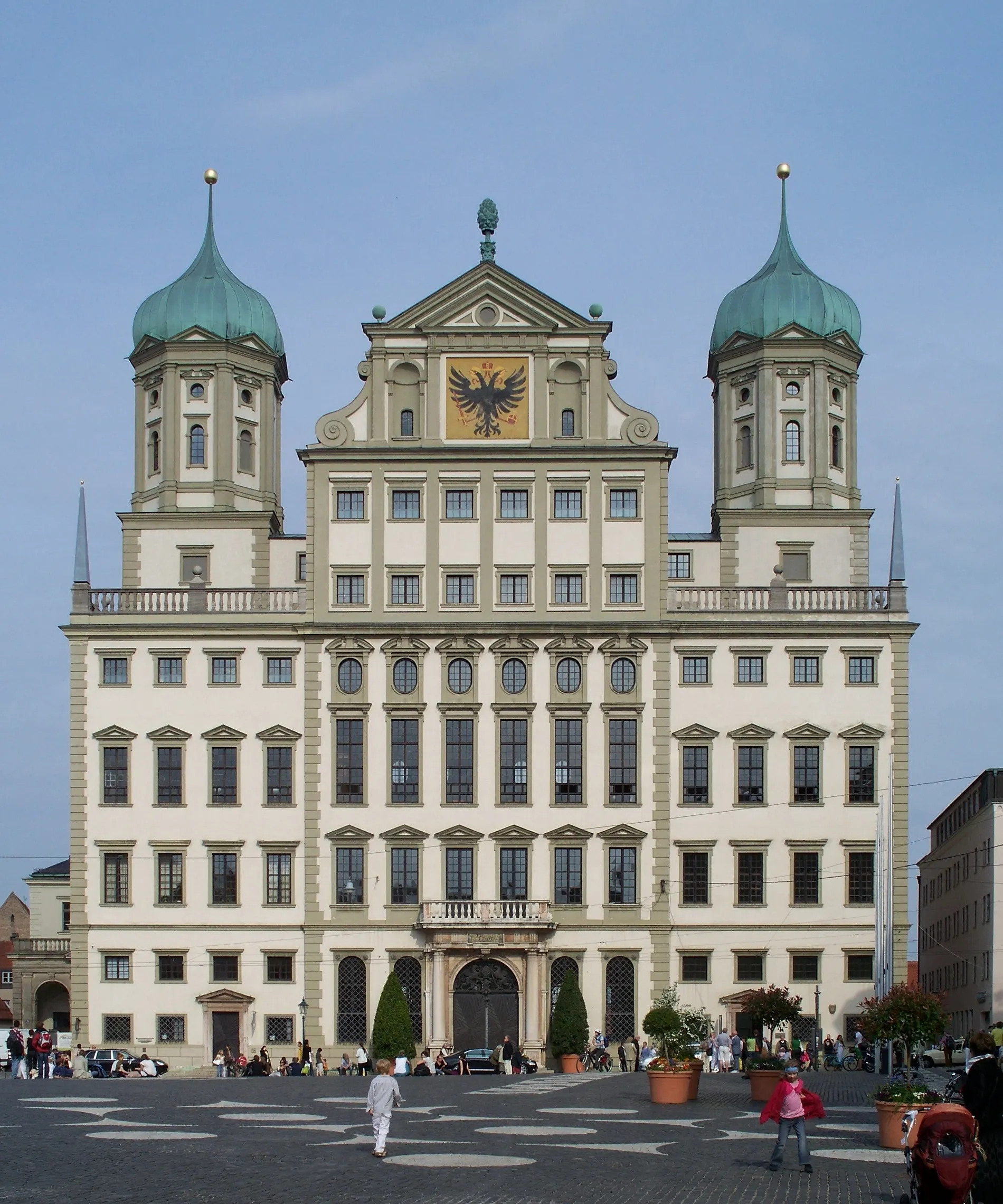
Augsburg Town Hall
Elias Holl built this seven-story Renaissance masterpiece between 1615 and 1624 to replace a Gothic town hall that no longer matched the ambitions of a Free Imperial City. Its interior centrepiece, the Goldener Saal, covers 552 square metres and was decorated with 23.5-carat gold leaf, destroyed in a 1944 bombing raid and painstakingly restored by 1996.
-
02
Fuggerei
Founded in 1521 by Jakob Fugger the Rich, the Fuggerei is the world's oldest social housing complex still in use, and tenants today pay the same annual rent of one Rhenish guilder (0.88 euros) that was set five centuries ago. In return, residents pray three times daily for the Fugger family.
-
03
Augsburg Cathedral
The cathedral holds the oldest stained glass cycle in the world, with windows dating to the 11th century still in place, and it remains the only preserved Ottonian bishop's church in Germany. Construction began in 995 under Bishop Liutold, supported by Empress Adelheid.
-
04
Basilica of St. Ulrich and Afra
The site has been a place of worship since the 4th century, when Saint Afra was martyred here during Emperor Diocletian's persecution. The current late Gothic church, capped by a 93-metre onion-domed tower completed in 1594, hosted a concert by the young Mozart in 1777.
-
05
Augustus Fountain
Completed in 1594 to mark Augsburg's 1,600th anniversary, this bronze and marble fountain by Dutch sculptor Hubert Gerhard was originally gold-coloured. It anchors the three-fountain ensemble on Maximilianstraße that became part of the UNESCO World Heritage water management system in 2019.
-
06
Augsburg Ice Canal
Built between 1970 and 1971 as an ice diversion channel protecting waterworks turbines, it was repurposed into the world's first artificial whitewater canoe slalom course for the 1972 Munich Olympics, a design that has since influenced more than fifty facilities across eighteen countries.
-
07
Bird Gate
A carved stone figure on the facade of this 1445 Gothic brick tower appears to comment wryly on passers-by, and the gate's name may derive either from Mayor Konrad Vögelin who commissioned it or from a bird catcher who lived in the predecessor building. The tower was severely damaged in 1944 and restored in 1954.
-
08
45 more places to discover
In the Parroo app
Good to know
52 researched places, from the Augsburg Town Hall and the Fuggerei to lesser-known spots like the Bird Gate. Each one has a short summary, a full article, and a ~3-minute audio story.
Yes. Every place has a ~3-minute audio story, written from the perspective of a guide standing next to you and produced with premium narration, not the article read aloud.
German, English, and French. Pick whichever you'd rather read or listen in.
No booking, no signup. It's a self-guided walk you start whenever you like. You do need a connection for now to stream the audio and load articles; offline support is something we're still building.
A one-time €4.99 for the whole city, no subscription and no recurring cost. You buy Augsburg once and keep access to all 52 places with text and audio.
Nearby cities
Open this city in Parroo
Get the full articles, audio stories, and map for this city in the Parroo app. One payment per geography. Yours to keep.
Updated: 2026-09-25