
Coverage Germany
Audio Guide Kassel
app, one-time €4.99
Kassel is the city that gave the world Grimms' fairy tales, a UNESCO-listed hilltop park, and documenta, one of the most influential contemporary art exhibitions on the planet. Its landmarks range from a Baroque Hercules standing 71 metres above the city to a Renaissance building that started as Germany's first permanent theatre and ended up full of elephant skeletons.
36+ researched places in the app
Yes. Parroo is a self-guided audio guide for Kassel: 36 researched places, from Wilhelmshöhe Mountain Park (UNESCO) to Hercules Monument and Wilhelmshöhe Palace, each with a short summary, a full article, and a roughly three-minute audio story in German, English, and French. Buy once, no subscription, no booking. Start whenever you like.
Audio sample: Wilhelmshöhe Mountain Park (UNESCO)
Kassel
Places researched in this city
A selection of the 36 places we've researched in this city. The full set is in the Parroo app.
- Baroque palaces
- UNESCO hillside park
- Gothic church
- Contemporary art
- Brothers Grimm museum
-
01
Wilhelmshöhe Mountain Park (UNESCO)
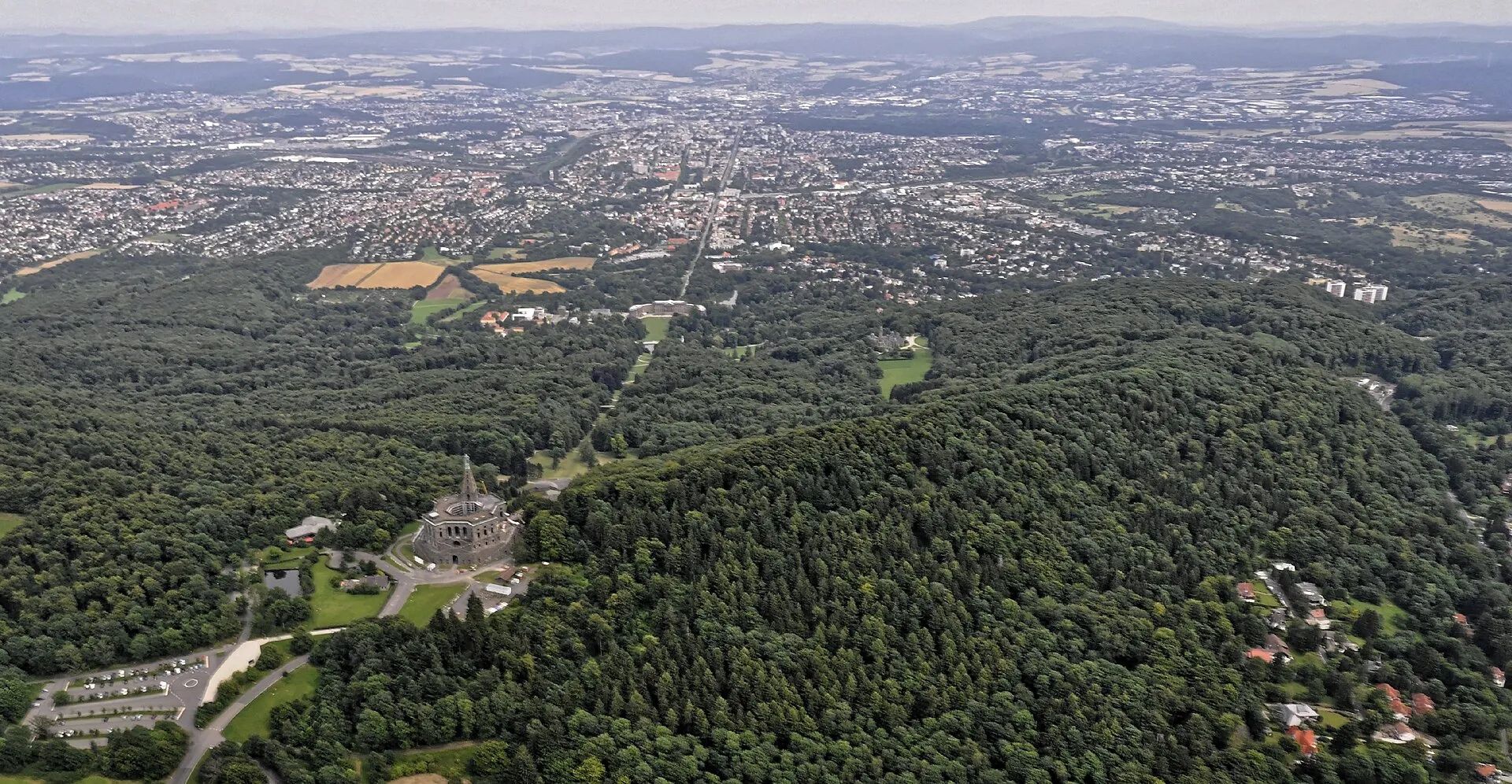
The gravity-fed water cascades here run entirely without pumps, using 750,000 litres of water to tumble down from the Hercules monument to the valley below. Europe's largest hillside park was started in 1689 by Landgrave Charles I and inscribed as a UNESCO World Heritage Site in 2013.
-
02
Hercules Monument
The 8.3-metre copper Hercules perched on top of this 71-metre Baroque tower is modelled on the ancient Farnese Hercules and was completed in 1717 by Italian architect Giovanni Francesco Guerniero. It doubles as the starting point for the park's remarkable pumpless water displays.
-
03
Wilhelmshöhe Palace
Napoleon's nephew Jerome Bonaparte lived here as King of Westphalia, and the palace later held Napoleon III as a prisoner after the Battle of Sedan in 1870. Built between 1786 and 1798, it now houses the Gemäldegalerie Alte Meister inside the UNESCO park.
-
04
Fridericianum Museum
Founded in 1779, this is one of the world's first public museums, and between 1810 and 1813 it briefly served as Germany's first parliamentary building under King Jérôme Bonaparte. Since 1955 it has been the anchor venue for documenta, the quinquennial contemporary art exhibition.
-
05
GRIMMWELT Kassel
Kassel was where Jacob and Wilhelm Grimm lived and worked when they compiled their famous fairy tales, and this museum opened in 2015 as the world's largest exhibition dedicated to their legacy. Its roof continues the slope of the historic Weinberg hill, making the building almost disappear into the landscape.
-
06
Ottoneum (Natural History Museum Kassel)
Built between 1603 and 1606, this is Germany's first permanent theatre building, though it spent much of the Thirty Years' War being used as a cannon foundry. Today it houses a natural history museum containing a skeleton the Goethe Elephant and a library made entirely of wood samples.
-
07
Lion's Castle (Löwenburg)
This Neo-Gothic castle inside the Wilhelmshöhe park was deliberately designed and built as an artificial ruin between 1793 and 1801, making it one of Germany's earliest examples of the Gothic Revival style. Its inspiration came partly from Strawberry Hill House in England, built in 1749.
-
08
29 more places to discover
In the Parroo app
Good to know
36 researched places, from the Hercules Monument and Wilhelmshöhe Palace to lesser-known spots like the Ottoneum, Germany's first permanent theatre turned natural history museum. Each one has a short summary, a full article, and a ~3-minute audio story.
Yes. Every place has a ~3-minute audio story, written from the perspective of a guide standing next to you and produced with premium narration, not the article read aloud.
German, English, and French. Pick whichever you'd rather read or listen in.
No booking, no signup. It's a self-guided walk you start whenever you like. You do need a connection for now to stream the audio and load articles; offline support is something we're still building.
A one-time €4.99 for the whole city, no subscription and no recurring cost. You buy Kassel once and keep access to all 36 places with text and audio.
Open this city in Parroo
Get the full articles, audio stories, and map for this city in the Parroo app. One payment per geography. Yours to keep.
Updated: 2026-09-25