
Coverage France
Audio Guide Calais
app, one-time €4.99
Calais sits at the narrowest point of the English Channel, where the English coast is visible on a clear day and 800 years of cross-Channel history have left their mark on every square and street. The city that withstood a year-long siege in 1347, spent two centuries under English rule, and built a global lace industry has more to show than its ferry port suggests.
33+ researched places in the app
Yes. Parroo is a self-guided audio guide for Calais: 33 researched places, from The Burghers of Calais to Calais Town Hall and The Watchtower, each with a short summary, a full article, and a roughly three-minute audio story in German, English, and French. Buy once, no subscription, no booking. Start whenever you like.
Audio sample: The Burghers of Calais
Calais
Places researched in this city
A selection of the 33 places we've researched in this city. The full set is in the Parroo app.
- Medieval monuments
- Rodin sculpture
- Lace heritage
- WWII bunkers
- Flemish civic architecture
- Maritime district
-
01
The Burghers of Calais
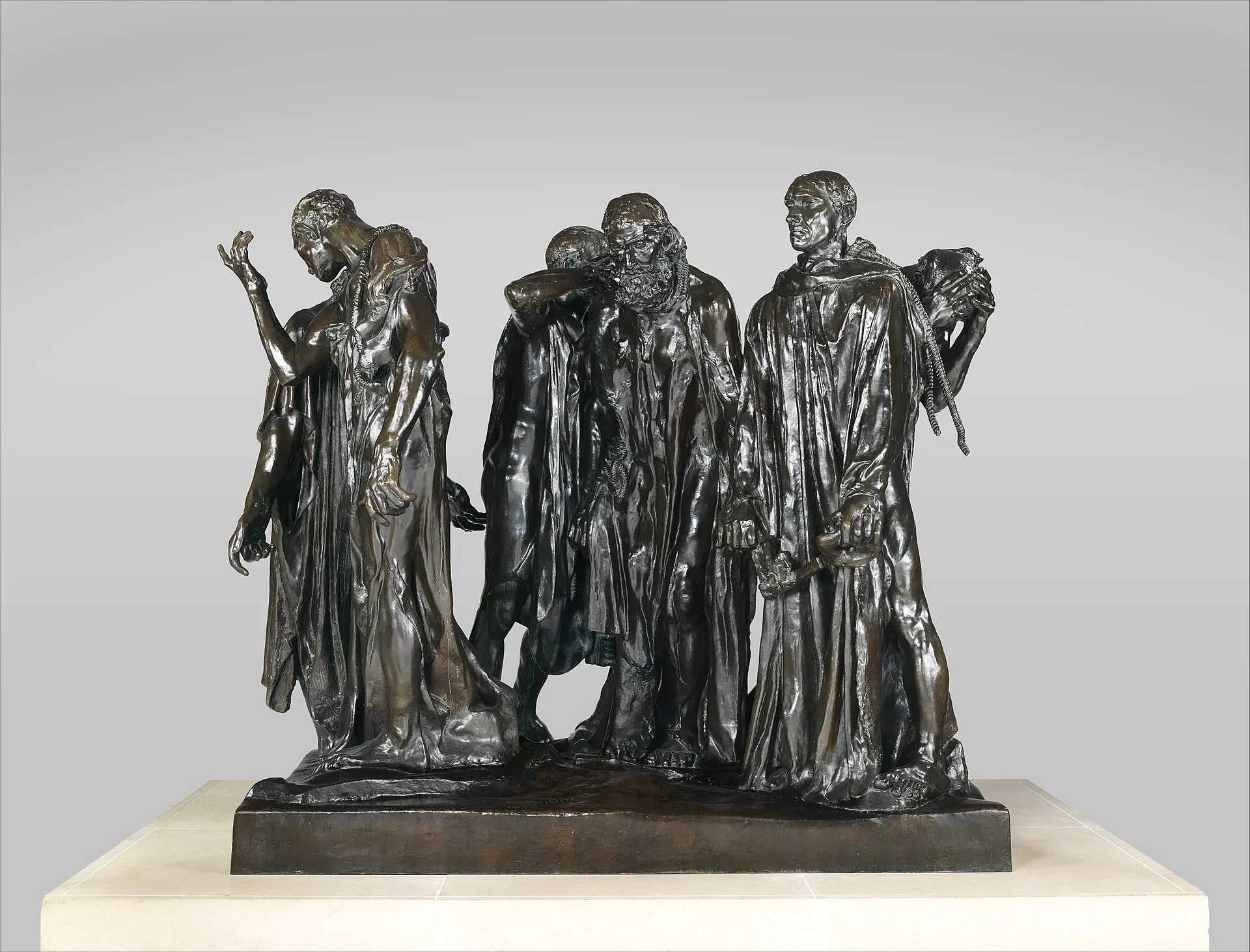
Rodin refused to put his 1884 sculpture on a pedestal, placing the six men who offered themselves as hostages to save the city in 1347 at street level so viewers stand among them rather than looking up at heroes. Twelve bronze casts exist worldwide, but this is where the story happened.
-
02
Calais Town Hall
The foundation stone was laid in 1911 on a sandy patch locals called the Sahara, chosen precisely because it lay between the two rival towns of Calais and Saint-Pierre to signal their 1885 merger. Charles de Gaulle married inside, and the 75-metre belfry is a UNESCO World Heritage site.
-
03
The Watchtower
Built around 1220, the Tour du Guet has served as a siege lookout, a lighthouse with a fire at its summit, and a telegraph station across its 800-year life. It stood at the centre of events when the six burghers surrendered to Edward III on the square directly below it.
-
04
City of Lace and Fashion
The Cité de la Dentelle et de la Mode opened in 2009 inside a former lace factory that ran from the 1870s until 2000, and its Leavers looms still run live during visits. Calais produces around 60 percent of the world's handmade lace, a fact the museum makes tangible rather than merely claiming it.
-
05
The Calais Lighthouse
Commissioned in 1848 by Louis-Philippe on the site of a former military bastion, the 51-metre lighthouse replaced a medieval watchtower as the main beacon for ships navigating one of the world's busiest shipping lanes. It was electrified in 1883 and is still operational today.
-
06
Memory Museum 39-45
The museum sits inside a German bunker whose concrete walls are over two metres thick, built in 1941 inside Saint-Pierre Park without most civilians realising what was being constructed beneath their public garden. Canadian forces found it intact when they liberated Calais on 30 September 1944.
-
07
Paradise Basin
The Bassin du Paradis takes its name not from any poetic aspiration but from the English Paradise family, influential merchants during the two centuries of English occupation. Its mooring bollards are repurposed artillery cannons, and it remains the oldest surviving section of Calais's medieval port.
-
08
26 more places to discover
In the Parroo app
Good to know
33 researched places, from the Burghers of Calais and the UNESCO-listed Town Hall belfry to lesser-known spots like the Paradise Basin. Each one has a short summary, a full article, and a ~3-minute audio story.
Yes. Every place has a ~3-minute audio story, written from the perspective of a guide standing next to you and produced with premium narration, not the article read aloud.
German, English, and French. Pick whichever you'd rather read or listen in.
No booking, no signup. It's a self-guided walk you start whenever you like. You do need a connection for now to stream the audio and load articles; offline support is something we're still building.
A one-time €4.99 for the whole city, no subscription and no recurring cost. You buy Calais once and keep access to all 33 places with text and audio.
Nearby cities
Open this city in Parroo
Get the full articles, audio stories, and map for this city in the Parroo app. One payment per geography. Yours to keep.
Updated: 2026-09-25