
Coverage France
Audio Guide Arras
app, one-time €4.99
Arras is a city shaped by deep time: its Flemish Baroque squares survived two world wars (just barely), and beneath its streets lies a chalk labyrinth that once sheltered entire armies. The Grand'Place, ringed by 155 ornate gabled facades, gives you the architecture; the Wellington Quarry gives you the city's remarkable underground life.
27+ researched places in the app
Yes. Parroo is a self-guided audio guide for Arras: 27 researched places, from Grand'Place d'Arras to Belfry of Arras and Wellington Quarry, each with a short summary, a full article, and a roughly three-minute audio story in German, English, and French. Buy once, no subscription, no booking. Start whenever you like.
Audio sample: Grand'Place d'Arras
Arras
Places researched in this city
A selection of the 27 places we've researched in this city. The full set is in the Parroo app.
- Flemish Baroque squares
- WWI memorials
- Underground galleries
- Gothic belfry
- Neoclassical cathedral
- Canadian memorial
-
01
Grand'Place d'Arras
The last jousts held on this square in 1435 involved around 3,400 horses over two days, and a monolithic column still marks the spot where Baldwin V of Flanders was supposedly born in 1004. Today the 184-by-96-metre square is flanked by 155 Flemish Baroque facades, all reconstructed after WWI to their original designs.
-
02
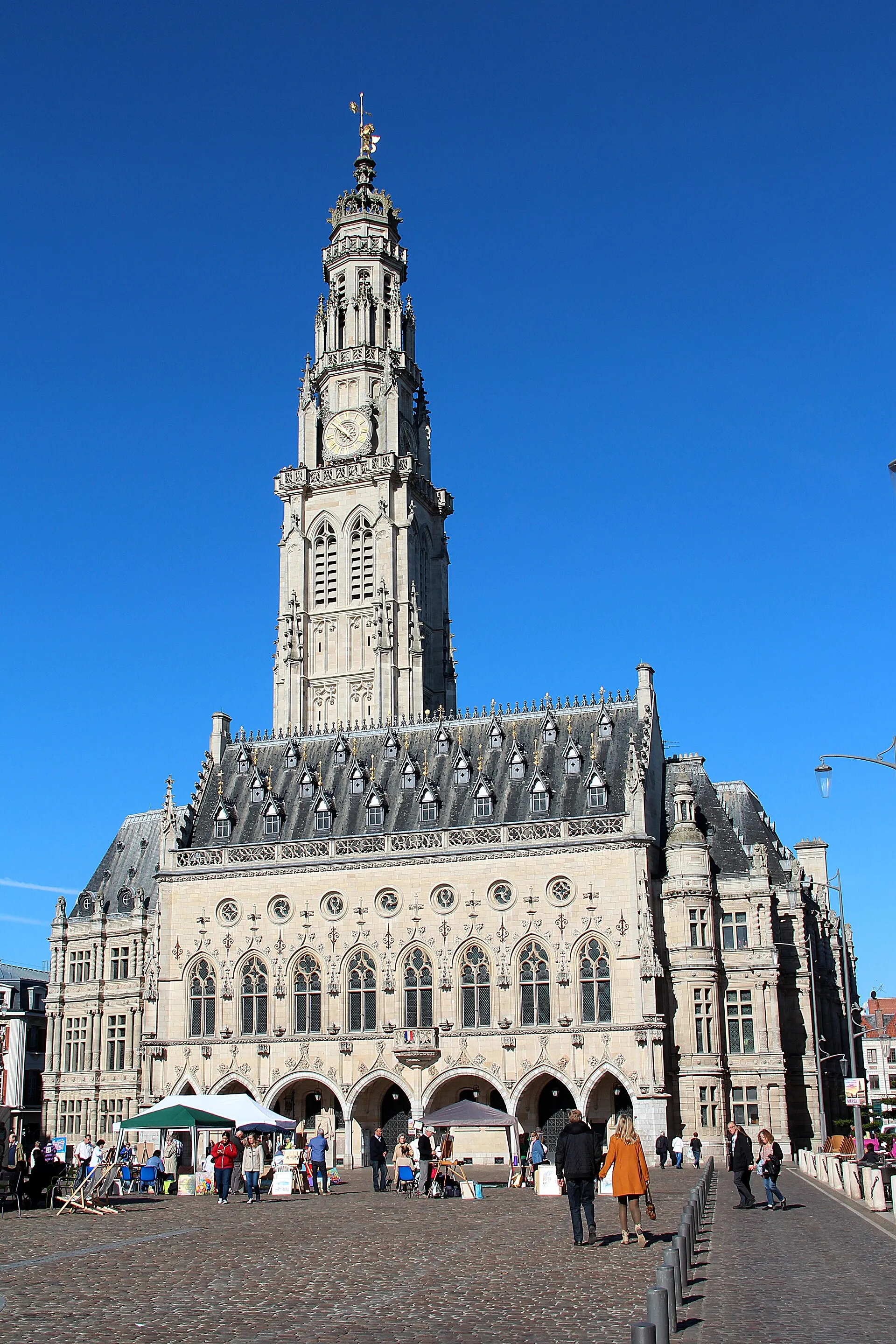
Belfry of Arras
Construction started in 1463, stalled at 35 metres for decades because of the wars of succession of Charles the Bold, and was finally topped off in 1554 with its distinctive octagonal crown and lion emblem. Destroyed in 1914, the 75-metre tower was rebuilt using reinforced concrete and is now a UNESCO World Heritage site carrying a carillon of 37 bells.
-
03
Wellington Quarry
New Zealand tunnellers connected centuries-old chalk quarries in 1916-1917 to create a 20-kilometre underground city that housed 24,000 soldiers the night before the Battle of Arras. The galleries sit 20 metres below street level at a constant 11°C, and soldiers' carvings still mark the tunnel walls.
-
04
Canadian National Vimy Memorial
Walter Seymour Allward's design was chosen from roughly 160 competition submissions in 1921, and construction required 11,000 tonnes of concrete and 6,000 tonnes of Croatian Seget limestone to complete by 1936. The twin pylons rise 27 metres above Hill 145, the ridge captured by Canadian forces in April 1917.
-
05
Notre-Dame-de-Lorette National Cemetery
France's largest military cemetery consolidates remains from over 150 provisional burial sites, honouring more than 40,000 soldiers on a hill that saw continuous combat from 1914 to 1917. The site began as a small oratory built in 1727 by a painter in gratitude for a healing he attributed to a pilgrimage to Loreto, Italy.
-
06
Citadel of Arras (Vauban Citadel)
Vauban built this pentagonal fortress for Louis XIV between 1668 and 1672, and it was so well-designed that it was never once besieged, earning the nickname 'la belle inutile' (the beautiful useless one). Three centuries later, its ditches and walls served a grimmer purpose: the site of executions of 218 resistance fighters during the German occupation in WWII.
-
07
Ring of Memory
Philippe Prost's elliptical steel structure lists 579,606 names on 500 plates arranged with no distinction by nationality, rank, or religion, a deliberate break from every war memorial that came before it. Weighing 300 tonnes and measuring 345 metres in circumference, it was inaugurated on 11 November 2014 for the WWI centennial.
-
08
20 more places to discover
In the Parroo app
Good to know
27 researched places, from the Grand'Place and the Wellington Quarry to lesser-known spots like the Ring of Memory. Each one has a short summary, a full article, and a ~3-minute audio story.
Yes. Every place has a ~3-minute audio story, written from the perspective of a guide standing next to you and produced with premium narration, not the article read aloud.
German, English, and French. Pick whichever you'd rather read or listen in.
No booking, no signup. It's a self-guided walk you start whenever you like. You do need a connection for now to stream the audio and load articles; offline support is something we're still building.
A one-time €4.99 for the whole city, no subscription and no recurring cost. You buy Arras once and keep access to all 27 places with text and audio.
Nearby cities
Open this city in Parroo
Get the full articles, audio stories, and map for this city in the Parroo app. One payment per geography. Yours to keep.
Updated: 2026-09-25