
Coverage France
Audio Guide Aix-en-Provence
app, one-time €4.99
Aix-en-Provence was founded by the Romans in 122 BC as Aquae Sextiae, built around thermal springs that still bubble through the city's fountains today. It grew into the residence of the Counts of Provence, then a city of lawyers and aristocrats who lined the Cours Mirabeau with grand mansions, and later the hometown of Paul Cézanne, whose obsession with Montagne Sainte-Victoire changed the course of modern art. With 40 researched places, the city rewards slow walkers who look past the obvious.
41+ researched places in the app
Yes. Parroo is a self-guided audio guide for Aix-en-Provence: 41 researched places, from Cours Mirabeau to Saint-Sauveur Cathedral and Montagne Sainte-Victoire, each with a short summary, a full article, and a roughly three-minute audio story in German, English, and French. Buy once, no subscription, no booking. Start whenever you like.
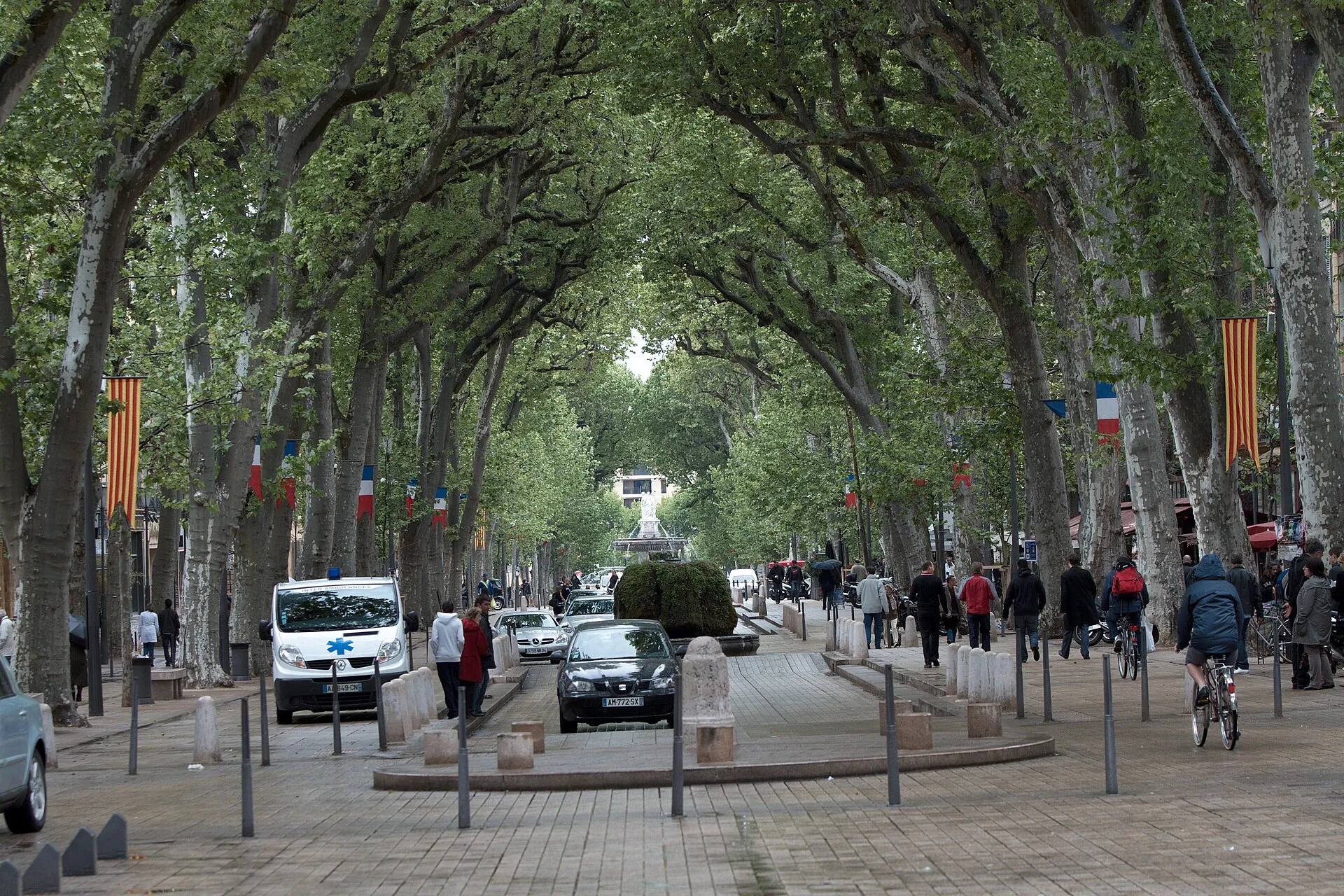
Audio sample: Cours Mirabeau
Aix-en-Provence
Places researched in this city
A selection of the 41 places we've researched in this city. The full set is in the Parroo app.
- Grand avenues
- Baroque fountains
- Gothic cathedral
- Cézanne sites
- Roman quarries
- 17th-century quarters
-
01
Cours Mirabeau
This 440-metre avenue was not designed for strolling: Archbishop Michel Mazarin ordered it built in the 17th century by demolishing the city's own ramparts to give the bourgeoisie a prestigious carriage road. The plane trees, grand mansions and café terraces that followed turned it into the social spine of Aix.
-
02
Saint-Sauveur Cathedral
Built on the site of a Roman forum that may itself have stood on a temple to Apollo, the cathedral layers thirteen centuries of construction into a single building, from a 5th-century baptistery to a Baroque nave. Its 1476 Burning Bush triptych by Nicolas Froment is still brought out for special occasions.
-
03
Montagne Sainte-Victoire
Cézanne painted this limestone ridge in 44 oil paintings and 43 watercolors, yet the mountain was already ancient history before he arrived: it was formed roughly 80 million years ago and has been occupied by humans since the Neolithic. At 1,011 metres, it draws around 750,000 visitors a year.
-
04
Cézanne's Studio
Cézanne built this two-storey stone studio on the Lauves hill in 1902 after the sale of his family property, and worked here until his death in 1906. The large wall slot that let him slide tall canvases in and out is still visible, and his personal objects remain exactly where he left them.
-
05
Fountain of King René
The statue atop this neoclassical fountain holds a bunch of Muscat grapes because René of Anjou is credited with introducing that variety to Provence. Sculpted by David d'Angers and inaugurated in 1823, the marble figure weighs 6.6 tonnes and marks the eastern end of the Cours Mirabeau.
-
06
Bibémus Quarries
The ochre molasse stone that gives Aix its warm colour was cut from these quarries east of the city, and the stone from here built the Town Hall and the mansions of the Mazarin quarter. Between 1895 and 1904, Cézanne painted 27 works among the geometric rock faces, producing compositions that directly anticipated Cubism.
-
07
Place d'Albertas
This Rococo square was not a civic project but a private vanity: between 1735 and 1741 the Albertas family bought up and demolished the houses opposite their own mansion simply to create an open view. The wrought-iron balconies they commissioned contain decorative symbols that locals have long read as quietly obscene, a detail the guidebooks tend to skip.
-
08
34 more places to discover
In the Parroo app
Good to know
41 researched places, from the Cours Mirabeau and Saint-Sauveur Cathedral to lesser-known spots like the Bibémus Quarries. Each one has a short summary, a full article, and a ~3-minute audio story.
Yes. Every place has a ~3-minute audio story, written from the perspective of a guide standing next to you and produced with premium narration, not the article read aloud.
German, English, and French. Pick whichever you'd rather read or listen in.
No booking, no signup. It's a self-guided walk you start whenever you like. You do need a connection for now to stream the audio and load articles; offline support is something we're still building.
A one-time €4.99 for the whole city, no subscription and no recurring cost. You buy Aix-en-Provence once and keep access to all 41 places with text and audio.
Open this city in Parroo
Get the full articles, audio stories, and map for this city in the Parroo app. One payment per geography. Yours to keep.
Updated: 2026-09-25